RSS
Facebook
Twitter

Showing posts with label Sex. Show all posts

Saturday, January 4, 2014

Not everything in life is muddled and befuddled

Ben Southwood left the following comment worth remarking upon in the thread on a previous post concerning feminism's War on Biology:
Mainly interesting and reasonably plausible, but the bit about female entry into the labour market and wages is almost certainly untrue, something I'd bet practically any economist could agree on. When a woman enters the labour force she adds to demand as well as supply. When this sort of argument comes from someone with other reasons they don't like women working, then it sounds very much like motivated reasoning.
Perhaps, though it seems nearly every economist professes to believe that immigration exerts no meaningful downward pressure on wages, too, and I'm unconvinced on that front as well!

In fact, I think there is a lot of overlap in the two fallacies. Adding wage earners will increase total consumer spending, but that's not what anyone outside of GMU cares about. The important issue is whether or not it raises per capita spending power. Annexing Mexico tomorrow would increase the United States' GDP by 8% in one fell swoop, but we'd be a poorer country as a consequence.

If the new wage earners earn more than the existing wage earners, then it is possible (though not necessarily the case) that income per wage earner will increase overall, but if the new wage earners earn less than the existing wage earners--as is overwhelming the case in the US with both women and immigrants--per capita wages are going to stagnate or even decline despite improvements in productivity. Additionally, a growing labor pool and the subsequent increase in competition among wage earners that larger labor pool brings with it, allows those who own the means of production to reap more benefit from productivity gains than those who work for them as employees do. That's been the story for decades now.

Women continue to earn less than men not because of irrational discrimination in the workplace--if that was the case, you or I could get rich tomorrow by starting a firm in an industry where such irrational discrimination is commonplace, overwhelmingly hire the qualified, underpaid women in the field who are getting snubbed, and watch the profits flow in... Okay, that's hyperbolic and oversimplified, and there is of course some level of irrationality in virtually all human affairs, but this sort of irrational discrimination is isolated and marginal in the contemporary scheme of things.

Instead, it is because they are less interested in and less devoted to their careers than men are for obvious biological and cultural reasons--reasons that the vast majority of people instinctively understand. Additionally, they aren't as adept men in industries that pay exceptionally well--primarily those requiring lots of high level math, like engineering and physics.

Parenthetically, immigrants in the US earn less than natives because they tend to be less educated, less intelligent, and less entrepreneurial than indigenous Americans are, and the gap doesn't close even after multiple generations of their descendants have been in the country.

Sunday, December 1, 2013

Sharing is caring?

Heartiste from a few years ago:
The verdict is in: Women want men to cheat on them. Oh sure, they don’t *consciously* want their men to cheat, but unbeknownst to all but the most self aware women, their ginas tingle uncontrollably for men who can — and do — score some poon on the side.
In the vast majority (though likely not all, female sexual variation being what it is) of cases, there's no question that the first part of the assertion--that women tend to be attracted to men who other women are attracted to--is indisputable. Women want you to be capable of cheating. Then again, men want the women they are banging--at least the ones who arouse them more than their own pillows do--to be able to cheat, too, but if they've signed up for the relationship thing, virtually none of them actually want the women to go through with it (if you're not a regular reader here, yes, I'm quite aware that men and women are anatomically, biologically, psychologically, politically, sexually, emotionally, cognitively, etc etc different from one another).

What about the latter part, though? Do they actually want you to dip your pen in another woman's ink? It's difficult to make sense of why, from an evolutionary perspective, females would want their mates to sire offspring with (and presumably provide resources to) other women. The hindbrain isn't going to make distinctions between copulation and procreation when it comes to their men getting with other women, so this is not a straw man argument, it's the logical extension of what Heartiste claims.

The following table shows the percentages of men who were (still) married at the time of their participation in the survey by whether or not they had ever cheated on their spouses and the percentages of men who were divorced or separated when given the survey by whether or not they had ever cheated on their spouses while they were married. For contemporary relevance and racial confounding, all responses are from 2000 onward and only non-Hispanic whites are included, respectively. The relevant questions are posed in such a way that those who have never married are necessarily excluded (N = 3,218):

White menStill MarriedSep/Divorced
Cheaters16.037.2
Faithful84.062.8

Men from failed marriages are more than twice as likely to have cheated before those marriages officially came apart than are men from marriages that are still in tact.

No, this does not obviously constitute a refutation of Heartiste's assertion. The limitations of a broad based survey like the GSS preclude digging as deeply as would be required for us to take a shot at evaluating that.

For one, we don't have data on who initiated the divorces and separations--how frequently do the men who are cheating leave the marriage because they're ready to trade in the old ride for a new model or simply go back to leasing altogether? How frequently do the women who find out about the cheating break off the marriage as a consequence? We also lack data on if the women who have been cheated on--whether the men who did the cheating are still married or since separated or divorced--were aware of the cheating when it took place, subsequently became aware of it, or remained in the dark up to the point when the responses were given. Finally, we don't know if the married men who have cheated on a spouse were, at the time they partook in the survey, still married to the women they cheated on or if they'd divorced and then remarried someone new (though knowledge on that front would probably just accentuate the relationship between cheating and divorce rather than attenuating or inverting it).

GSS variables used: EVSTRAY(1-2), MARITAL(1)(3-4), RACECEN1(1), YEAR(2000-2012), SEX(1)

Tuesday, November 19, 2013

They aren't meant to pee standing up

++Addition++Staffan points out that, according to Google's Ngram viewer, the concept of feminism as an organizing principle is in decline:


How much of that is due to realization of biological differences and how much is due to female concerns being superseded by the concerns of 'victim' classes like blacks and gays who higher up on the victimology pyramid?

---

Gavin McInnes went into the HuffPo harpy's nest to--colorfully, as is his wont--assert that women tend to be happier following their maternal instincts than they are devoting all their energy to getting ahead in the rat race. He was met with lots of supercilious condescension but, predictably, nothing he asserted was empirically challenged. Unfortunately, his empirical grounding was insinuated rather than explicitly presented. The GSS can aid him in the future.

For starters, let's look at feminism as an idea. In the mid-nineties, the GSS asked respondents whether or not they considered themselves feminists. Self-described feminists, despite being modestly better educated, more intelligent (based on wordsum scores), and wealthier than those who didn't identify as such, reported lower levels of personal happiness than non-feminists. The following table shows the feminist/non-feminist breakdown among women who describe themselves as "very happy", "pretty happy", and "not too happy":

HappinessFeministsNormals
Very happy24.5%75.5%
Pretty happy27.8%72.2%
Not too happy34.4%65.6%

Feminists comprise less than one-quarter of women who are "very happy" but over one-third of those who are "not too happy".

Sure, the argument can be made that happiness is subjective and even though the non-feminists are more content, they're not objectively doing as well since they don't have as much money or education as the feminists do. That line of reasoning doesn't contradict McInnes' point, though. Instead, it strengthens it. Making that sort of judgment in favor of feminists because of career success is to assess female success by traditionally male--that is, masculine--standards, and the women whose lives more resemble men in this regard express lower levels of happiness than do women who travel life's more traditionally feminine path.

If that's overly abstract, let's take a look from another angle, one of social cohesion. In 2004, the GSS conducted a special module querying respondents on the most important aspect of their identities. Participants were able to choose from a list of ten, three of which are of special relevance to this discussion--occupation, gender, and family/marital status. The following table shows, among women who indicated one of those three identifiers as most important to defining who they are, the percentages who are "very proud", "somewhat proud", and "not very proud" of being American:

Identifies byVery proudSomewhat proudNot very proud
Occupation78.3%18.7%3.0%
Gender70.2%26.0%3.8%
Family/marital status84.3%14.3%1.3%

Women who are women, first and foremost, are the least content with the society they live in, those who most strongly identify with their work more middling, and those who care most about hearth and heart the most satisfied with it.

The survey also shows that, across a variety of measures, men are more willing than women are to make sacrifices--overtime, odd shifts, etc--in other areas of their lives for the sake of work. The converse of this, of course, is that women are less willing to put work ahead of other areas of life, like, say, raising a family.

What about the perceptions broader society has regarding what is, generally, the more preferable way for families to be raised? Collected in 2012, these figures still have that new car smell. The tables are reposted here from a post put together earlier this year. The following table shows the percentages of respondents who identified each of the following six scenarios as the most ideal:

Arrangement, all responsesDist%
Mother home, father full-time39.7
Mother part-time, father full-time41.6
Both full-time11.3
Both part-time6.8
Father part-time, mother full-time0.2
Father home, mother full-time0.5

Looks like we need a runoff to decide whether or not the woman should be a full time homemaker or should instead enjoy occasional breaks from the homestead to earn a few bucks while dad takes the kids. Fewer than 1-in-100 think Mr. Mom is the way to go, and the dual careerist path where, in McInnes' words, "shaping a human life" is put on the back burner, isn't very popular either.

Some great victory women in the workforce has been! On the bright side, though, it's self-perpetuating objective--the more women there are working, the lower the wages both working men and working women are able to command, and consequently the greater the need for women to enter the workforce to make ends meet, let alone raise a family!

Perhaps it's skewed heavily by the patriarchal enforcers of patriarchy, the patriarchs themselves. The response results, this time with only women considered:

Arrangement, women onlyDist%
Mother home, father full-time33.6
Mother part-time, father full-time45.7
Both full-time11.7
Both part-time8.5
Father part-time, mother full-time0.2
Father home, mother full-time0.3

The vast majority--we're talking 4 out of 5--of Americans conceive of the ideal family environment being one in which a man works full-time and a woman works either part-time or not at all. It's as though they recognize some sort of special bond between a mother and the child her body spent nine devoted months bringing into the world.

Maybe the patriarchs have brainwashed their own barefoot wives slaving away in the kitchen into falling for the breadwinner-homemaker ideal, but what about women who think for themselves? Liberal women only (n = 130):

ArrangementDist%
Mother home, father full-time23.1
Mother part-time, father full-time48.4
Both full-time12.9
Both part-time15.0
Father part-time, mother full-time0.0
Father home, mother full-time0.6

The feminists may have three or four waves on their side, but McInnes has the tsunamic force of hundreds of thousands of years of evolutionary forces on his.

GSS variables used: SEX(2), HAPPY, FEMINIST, FAMWKBST(1-6), SEX(2), POLVIEWS(1-3), AMPROUD1(1-3), SOCID1(1,3,8)

Monday, October 28, 2013

Liberty and equality, stoics and epicureans

Just as there is an enormous amount of tension between the consular ideals of liberty and equality, so too is there in aspiring to provide the best health care available while simultaneously striving to make health care ubiquitous and universally accessible. Anti-Gnostic does a great job succinctly articulating as much, with the following excerpt of demonstrating particular perspicacity:
The whole point is that *old people are going to die* with probability 1. So let's take those evil capitalists out of the question, and assume for now that no innovative entrepreneur could figure out something win/win for his own grandpa. ... 
We are in the realm of social justice. Sounds so nice, until we answer the question: how much of your children's money do you want to spend on futile care for 83 year old Emma in Ohio? For 74 year old Bill in Texas? For countless, endless, unnamed others? 
Because you can spend ALL of your money on futile care [or, by extension, the government can spend it for you]. Literally every last penny.
Worth reading in full.

Abstractly, the strong appeal of liberty--potentially even stronger than that of equality in the much of the public's mind--is why, despite actual policy disagreements on crucial issues like immigration, I'm still excited by the rise of guys like Rand Paul.

Anyway, Heartiste first brought the above to my attention. Speaking of the galactic overlord, he gently censured his occasionally inimical dux for insinuating that the Game approach to classifying males has it backwards due to the tendency of betas to outbreed alphas (which should mean even more cleaning up by the remaining alphas!). At the risk of getting lost in semantic weeds, I'm fine granting the Manosphere its preferred terms and consequent definitions and then making empirical observations free of normative judgments from within this framework. Hopefully it's illuminating or at least interesting. All the better if it keeps our hero's skills at their sharpest.

To the extent that I'm grated at all by Heartiste, it's in his seeming celebration of what amounts to an ennui-inducing mix of realized hedonism and nihilism. His meaning is often as nuanced as his tongue is silver, and I suspect that beneath all the veils lies a volition more inclined towards using sexual conquest as a means to an end rather than an end to indulge in for it's own sake, despite protestations to the contrary. Oh yes he doth protest, but I don't buy it, which is why I'm compelled to play the role of affectionate gadfly rather than whiny hater.

This isn't all merely a philosophical rehashing of Stoic vs. Epicurean, either. You might not care about propagation, but propagation cares about you. It's plausible to imagine that in the not-so-distant future pleasure surpassing that coming to a "Super Alpha" on an A-game night will be made available to all on demand without any real life human interaction being required at all. Just as the reproductive edge has shifted away from alphas and towards betas over at least the last half century, so another seismic shifting in fecundity may be just around the bend. I want kindred souls to be ready for it.

Finally, a post like this wouldn't be complete without an added wrinkle or two. The data are a couple of decades old, but the GSS queried respondents in 1994 on whether or not they'd watched any pornography in the preceding year. Cross-referencing this with reported sex frequency, we find that men who had sex less than once a month over the same period of time were considerably less likely to have viewed pornographic material than men who had sex more frequently than that were to have viewed any (18.2% and 38.1%, respectively, N = 183). For more contemporary, if proxied, relevance, using male respondent data from 2000 onward, we find that men who report not having sex at all in the last year are more than twice as likely as men who enjoy it 4+ times per week to support an outright ban on pornographic material (36.9% and 16.5%, respectively, with a sizeable chunk of that 16.5% of 4+ times per week group presumably being comprised of social and religious conservatives). Pornography, at least from this angle, appears to be more of a supplement to real life carnality than a substitute for it.

Undoubtedly there are a lot of frustrated betas out there who would love to possess an alpha prowess with women, but there are also a lot of them who just aren't that interested in recreational sex (and I suspect the latter has been and continues to increase as a proportion of the total male population). This probably goes some way in explaining why the unending comment threads Heartiste generates are mostly populated by alphas echoing the taunts and diminutions of the beta no shows, who, while constituting a majority of the population, are far less likely to be found than sheer numbers would suggest. How much attention is this Silent Majority paying?

GSS variables used: XMOVIE1, SEXFREQ(0-2)(3-6)(0)(6), YEAR(2000-2012), SEX(1), PORNLAW(1)(2-3)

Monday, October 21, 2013

Boudica

Professional podcaster Jamie Jeffers, in a review of the History Channel's Vikings (which I've never seen), comments approvingly on the show's depiction of Lagertha*:
I really like the fact that they have a tough-as-nails warrior woman and they don't treat it like it's strange... they did an excellent job demonstrating that there were warrior women and warrior women were very effective. It does a good job dispelling a lot of the innate sexism that you run into.
Unsurprisingly, I don't like it.

Jeffers regularly juxtaposes the rigid gender distinctions certain ancient civilizations, like the Romans, made with the relatively more overlapping gender roles that existed among others such as the Norse or Celts, even employing the term "progressive" to describe the latter. In so doing, Jeffers projects a contemporary (and liberal, and western!) worldview to a past that was in many ways quite alien to anything existing within the prevailing mores and ethos of said contemporary worldview.

"Regressive" may be a synonym of "progressive"; "repressive", however, not necessarily so. I'd argue, in fact, that--and I'm generalizing as someone with a spotty amateur's knowledge of history--from the onset of the agricultural age through the Enlightenment, or maybe even the Industrial Revolution, the contextually more progressive (in the Hegelian sense of the word) societies tended to be the ones in which gender distinctions were relatively more, not less, pronounced. It was a natural outgrowth of specialization. Rather than being Jacks and Jills of all trades by necessity, people in more 'progressive' societies were able to become especially good at certain things and leverage these more specialized skills to obtain the products and services produced by others similarly become extraordinarily skilled in other things. It's not all John Locke and Adam Smith, though--similar forces were at work at other layers of society, not just the occupational ones.

Specifically, the relatively more sexually egalitarian tribes in Gaul and Brittania for which the employment of female warriors was not exceptionally remarkable were not 'ahead' of the Romans but instead were 'behind' them (history backs me up here). They used their women to join battle with their opponents and block the retreats of their own men because they had to. For a society to use women in hand-in-hand combat isn't very efficient--women are weaker, smaller, slower, and less physically aggressive than men are. Sometimes desperate times call for desperate measures, but just like arming the old, sickly, infirm, and untrained, what you gain in numbers you tend to lose in per capita fighting ability. Perhaps he used "disproportionate force", but Severus' actions become a little easier to comprehend, don't they?

Additionally, women are a more precious reproductive resource than men are. If, today, tribe Azure is comprised of 100 males and 50 females of reproductive age while tribe Fuchsia is comprised of 50 males and 100 females of the same condition, assuming no annihilation from hostile neighbors, which tribe is going to have more people--both male and female--of reproductive age a generation down the road? The male reproductive role takes fifteen minutes, the female role nine months (and a couple of decades of residual effort on top of that). At the high end, rates of reproduction are far more restricted by the number of fertile women in a society than they are by the number of fertile men.

Today, the rules of the game have changed, and it is indeed the case that in more progressive societies gender distinctions are less pronounced than they are in more regressive ones. Having shaken free of the Malthusian Trap centuries ago, the question of women assuming military roles in the contemporary West is no longer one of necessity but rather one of luxury--progressive societies are able to more easily afford putting women in harm's way. In the US, for example, the fighting capabilities of soldiers operating small arms and artillery just isn't a crucial or even important determinant of the nation's well being. We're not threatened militarily in any serious way and most of the casualties we do suffer are primarily the consequence of the ideologically-driven strategic decisions we make and tactics we forsake (ie sending marines into firefights in the mountains of Tora Bora and the streets of Baghdad rather than raining hell on these places from 30,000 feet above).

Indulging in the same sort of contemporary bias critically examined above, one might say that, in a historical context, Jeffers' take is an example of the bottom (those forced to equip everyone to fight) and the top (by those able to afford inefficiencies) uniting against the middle (those who are neither compelled by penury nor able to insouciantly engage in profligacy)!

* Anachronistic, yes, but it's historical fiction, not a documentary.

Thursday, October 3, 2013

The Pew Research Center is an honest organization that provides often interesting and useful data on social issues, public opinion and demographic trends. That assertion, though, needs to be qualified by pointing out that Pew is honest by way of commission, while it is often less so by way of omission. The center regularly conducts a survey entitled "News IQ" in which American adults are surveyed on their knowledge of current events.

If I recall correctly, Pew originally included racial breakdowns in the quiz results, though it stopped doing so several years ago and it looks as though Pew only maintains the most recent results on its site. Now it appears as though a stop to breaking down results by sex is imminent. Report results from the latest survey only separate out male and female responses for three questions that specifically have to do with women (tragically, men performed better on all three!). However, after completing the quiz online, results are broken down by sex, age, and educational attainment.

While men performed better on the three ostensibly girl power questions (identifying Marissa Mayer, the percentage of congress critters who are female, and female college graduation rates), women actually outscored men on two of the thirteen items, the two concerning subjects of elevated interest to many women--same-sex marriage and educational curricula. While sexless feminists might be interested in female figures engaged in traditionally masculine pursuits, most women are far more interested in traditionally (and biologically) feminine concerns like social inclusion and nurturing.

If Pew stops reporting results by sex, we're left with age (fairly predictable question by question and a dead giveaway overall), education (more obvious than the outcome of a Globetrotters-Generals game), and party affiliation (almost indistinguishable this time around).

One age-related result does catch the eye:


Percentages who correctly answered "Nigeria" by age range:

18-29 -- 47%
30-49 -- 45%
50-64 -- 43%
65+ -- 29%

The question is multiple choice with four possible answers, so old fogies are essentially oblivious to the specific differences in rates of fertility between various different countries in the world. You don't have to care about demographics for demographics to care about you, of course.

Saturday, September 21, 2013

Expendables are more interesting

Genetically, men are more expendable than women are. Historically for our species around 40% of men and 80% of women reproduced. Alphas ruled the past. But the biological world isn't static and significant evolutionary changes can occur in the geological blink of an eye. Today in the US the gap has narrowed substantially. The GSS shows that 81% of men and 86% of women who've made it through their reproductive careers have procreated. Genetic continuance is a lot more egalitarian than it used to be, especially for men. Fecundity is now a beta trait. Still, while we're not the same people who lived during ancient Roman times, let alone the same people as the first neolithic agriculturalists, we're not an alien species to them, either. Grok is relevant to us, even if he isn't exactly us.

If men are more expendable than women are, a presumable corollary is that, from a woman's perspective, characteristics of sexual attraction in men are more varied, more numerous, and less ubiquitous than the characteristics of sexual attraction in women are from the perspective of men. It takes a lot of time and effort for women to reproduce, and we need just about all of them to do it if the species is going to survive and prosper. Consequently, men overwhelmingly focus on signs of maximum fertility: Waist-to-hip ratio of 0.7, healthy and supple skin, perky breasts that appear to defy gravity, lack of current impregnation, etc. The rest is mostly marginal stuff.

We can afford to be less conservative when it comes to men's contributions, which works out well since male contributions are the stronger drivers of evolutionary changes. Women aren't primed to detect signs of fertility in men. They aren't any better at identifying said signs than (disinterested) men are, and it's presence is usually uncertain (though presumed to be there) unless the last stages of intimacy reveal otherwise. Yes, older and fatter guys are more likely to have issues, but even among these 'at risk' categories, most are capable. Pubescence is just about the only prerequisite--once that box is checked off, female attraction moves on to assess a whole host of other characteristics: Status (ie command of resources and of other people, not evincing a need of approval from other people whether they be male or female, etc), humor, height and general physical fitness, intelligence, kindness, self-confidence, etc, with different women putting varying amounts of emphases on different dimensions of a more variegated (and sometimes seemingly contradictory) suite of desirability markers. Men are more interesting, if not necessarily more infatuating.

Tell me if I'm missing something, merely stating the obvious, or being overly presumptive with an amateur's understanding of evolutionary psychology.

GSS variables used: CHILDS, SEX, AGE(40-65), YEAR(2000-2012)

Wednesday, July 24, 2013

Let's talk about self reported sex baby

Without fear or apology, as is his wont, Roissy/Heartiste has really stuck his neck out there as of late. If he is able to parlay his vast reach into the spread and absorption of HBD realism, then it is with hesitation and angst that I risk appearing as an adversary here. The man is fighting hard and gaining ground in Cisalpine Gaul, not piffling away in the swamps of Ravenna.

That paean sung, a couple of points of contention. Heartiste quotes one of his commenters at length, the remarkable portion being excerpted below. The commenter is referring to male-to-male competition in the field:
Sometimes if he’s frustrated enough he’ll try to tool me on my looks or money etc, something he puts value on so he thinks I’ll put value on, but 1) he’s just reacting to me at that point so he sabotages himself further in the girls’ eyes because the higher value person is the one who reacts less to the other person, and 2) I don’t build my self-worth around those external things so I’m not phased by it and will join in making fun of myself and be self-depreciating because I know my worth internally and know it has nothing to do with whatever he’s making fun of [emphasis mine]…the end result is if he does this, he takes himself from Check with the girls and puts himself in Check-mate and it’s over.
It is this sort of mentality that so frequently irks me in Game discussions. A lot of it is great--eat better, lift heavy things, be bold (even audacious!), have confidence, don't put up with tripe, celebrate your virility, know that there is no question that women love, love, love high status so get off your X-Box and go attain it--but the hoodwinking and deception undermines all of that (as well as the notion of female sexual selection being calibrated in any serious way that can't be fooled with a bit of scripting, and thus too the notion that female detection mechanisms are biologically serious). Put value on that stuff that he's tooling you on, too, because it's good for you, for women, and for society as a whole.

A cad isn't a flattering thing to be (high notch count, yes, but not necessarily high quality, and also disproportionately childless, leftist, black, unmarried, irreligious, and uneducated). Dominate them just like you dominate everything else in life. That's the alpha worth aspiring to.

Switching gears, Heartiste has ribbed quant bloggers like myself in the past on multiple occasions, specifically about our reliance on the questionable reliability of self-reported data on sexual behavior (although in fairness to Heartiste, he is more concerned about female misrepresentation than his is about male fabrication).

When the results are on his side, though, he's quick to toss that caution to the wind, as he did the other day in reporting on and analyzing a study showing that perceived male dominance trumps perceived male physical attractiveness when it comes to predicting the number of bangs a guy has. Dominance was measured by male raters assessing a man's perceived "fighting ability" while attractiveness was measured by female raters assessing a man's perceived "short-term attractiveness". These results were then cross-referenced with each evaluated man's self-reported number of lifetime sexual partners.

A cynic might wonder if there's a tendency for aggressive, high-testosterone types who missed humanity's gracility boat to inflate their numbers more than stencil-necked pretty boys who get mistaken for Justin Bieber do.

Parenthetically, while a little skepticism is always healthy, I put a fair amount of confidence responses. They don't often get us to the unadulterated truth, but they're something, and unless there are systematic rather than across-the-board skews, they are almost always useful for, if not obtaining absolute delineations, then at least for comparative purposes.

With regards to the study in question, I suspect that the researchers' (and Heartiste's) readings into the results get us part of the way there, and that the tendency for aggressive, pugilistic guys to engage in both more puffery and more intense and frequent sex seeking than slimmer, more laid back men do gets us down the rest of the road.

In any case, more researched is surely required!

Monday, July 1, 2013

Youths will be youths

As an addendum to the previous post, I suspected an age skew. Younger guys who buy cheap cigars are more likely to use them as blunts than older men are. The percentages of men aged 18-25 and aged 26+ who buy cigars and are active marijuana users, again defined as having smoked weed sometime in the last year:

Cigar18-25yo26+yo
Black and Milds21.3%12.4%
Swishers17.2%7.4%

Even among 'youths', though, it's more the exception than the rule.

2011 National Survey on Drug Use and Health variables used: CGR30BR2(404, 423), IRSEX(1), CIG30MLN(2-3), MRDAYPYR, CATAGE(2)(3-4)

Saturday, June 29, 2013

Reporting on what Justitia would surely regard as a hopeless and deeply unethical persecution prosecution, Jack Cashill writes:
Of note, Curly walked into the store with a couple of bills visible in his hand, likely the bills Martin exited with. Curly took the bills to the counter and bought two cheap cigars, or “blunts” as they are known on the street. The Urban Dictionary defines a “blunt” as a “cigar hollowed out and filled with marijuana.” Its virtue is that it can be smoked in public “somewhat inconspicuously.”
I've known people who smoke cigars as they are, but from personal experience I get the sense that much--if not most--of the time, they are purchased to be hollowed and used to smoke weed. Fortunately, the 2011 National Survey on Drug Use and Health allows me to see beyond the information my own lying eyes provide to me. The percentages of cigar buyers whose most purchased cigar brand is Black and Mild and Swisher Sweet, respectively (these being by far the two most popular cigar brands in the US), who are active marijuana users (defined here as someone who has smoked weed in the last year):

CigarWeed
Black and Milds15.5%
Swishers12.3%

I might be able to hang on to the "much", but "most" has to go. A significant minority of cheap cigar buyers are doing so to facilitate their marijuana usage, but most of them merely appreciate the love of a man for a fine Pennsylvanian cigar.

Tangentially, it's my impression that if you're a man and you smoke 100s, there's a good chance you're gay, since 100s are for women (and also that you're a prole, since smoking is for proles). I suspect this tendency is ratcheted up ten-fold if you smoke 120s. Unfortunately, the survey doesn't inquire about sexual orientation or 120s, however, so we'll have to settle with just considering regulars (or kings) and 100s, by sex. The gender breakdown among Marlboro* smokers by cigarette size (rows, not columns, sum to 100%):


MaleFemale
Kings59.9%40.1%
100s43.3%56.7%

Survey variables used: CGR30BR2(404, 423), IRSEX, CIG30MLN(2-3), MRDAYPYR

* The survey only poses this question to respondents who smoke Marlboros. Because it is a relatively masculine brand, the true overall tendencies towards smoking and thus size prefrences are probably shifted towards women in both cases, but by presumably similar degrees. The takeaway here is that indeed women prefer longs more than men do. Beyond image, it's putatively because 100s last longer and are less intense, both of which are qualities more descriptive of female pleasure than they are of male pleasure [/innuendo].

Tuesday, May 7, 2013

With the government-media complex highlighting sexual abuse in the US military as The Issue that now must be addressed straight, with gun control being a political loser, amnesty being undercut by the blatant immigration undertones of the Boston marathon bombing, and the taxing of online interstate sales having it's best chance of congressional approval if no one knows the critters are pushing it through--I thought I'd take a look at the primary source. With gays now being allowed to serve openly in the military, I also sensed an opportunity to cause some mischief.

The survey in question asks active duty personnel who have experienced "unwanted sexual contact" in the past year to focus on the most egregious incident when answering subsequent questions. Jumping out immediately is the fact that while the 2012 figure is higher than it was in 2010, results for 2006 are worse (as in a higher percentage of personnel reporting unwanted contact) than they were in either 2010 and 2012. This looks more like random year-to-year variation than an 'epidemic'. Personnel also report higher rates of unwanted sexual contact prior to becoming active duty military than they experienced after having enlisted. Lots of young, adventuresome singles in putatively stressful situations and there's less sexual harassment than there is in civilian life--when the percentage of people one comes into contact with who are potential sexual partners is often much lower than when on active duty--feels like a manufactured crisis to me.

Perhaps apprehensive that access to data broken down by sex of both offender and victim might give homophobes something to ream gays in the service with, data on offenders among female victims is reported but data on offenders for male victims is, inexplicably, not. The report simply reads "results for men are not reportable" (p32). Uh huh.

Fortunately, the data were broken out in 2010, and by employing a little algebra, we're able to glean from the latest report results from surveys conducted in previous years. The ratio of men-to-women who reported unwanted contact was nearly identical in both 2010 and 2012, with the latter showing an uptick of one-third more than 2010 for both men and women, so the following ratios almost certainly hold in 2012 even though I calculated them using data from 2010.

Things you're unlikely to see or hear reported from major media sources or pondered from the bully pulpit regarding sexual harassment among our active duty personnel:

- More men than women are on the receiving end of unwanted sexual contact--10,571 and 8,949 in 2010, respectively. Of course this is in absolute terms--women are still more likely to be victims of unwanted sexual contact than men are.

- According to the survey--conducted by the Defense Manpower Data Center (DMDC), operating under the Department of Defense--women are more than twice as likely as men are to perpetrate unwanted sexual contact, at least in situations in which the perpetrator(s) were of the same sex (a situation comprising 85% of all designated worst situations, the other 15% consisting of both men and women in a group making unwanted sexual contact with a victim). It strains credulity at first blush, but working from the tables provided on pages 34-36 and active duty personnel figures, we arrive at 12,326 total male offenders and 4,353 total female offenders* in an active duty service in which only about one-in-seven members are women. That translates to about 1 in 47 female personnel perpetrating unwanted sexual contact compared to just 1 in 95 male personnel doing so. Women are more likely to victimize and to be victimized than men are. Yet another reason that having them serve in the armed forces is such a swell idea.

- Relatedly, one-quarter (26%) of all unwanted sexual contact among active duty personnel involves women harrying men. One-half (52%) involves men getting after women, less than 1% consists of women sexually harassing other women, and the remaining cases (22%) involve men engaging in unwanted sexual contact with other men. I don't want my son's scout leader to be a gay guy or a woman. Heterosexual, please and thanks.

- Parenthetically, even if offending women in the military had a predilection for other female targets for their advances, it wouldn't be widely reported on. However, they don't. Offending women are more than eight times as likely to go after men as they are to go after women.

Beyond causing skepticism about the way the military goes about tracking sexual harassment, there are some potential story lines to go with these results--active duty women have clits as big as your di especially low digit ratios and the corresponding libidos to match, while men aren't that into these GI Janes. At least not for being red-blooded, mostly healthy trained killers, anyway.

Even less appealing, the number of active duty men who annually experience unwanted (homo)sexual contact from other men is in the high thousands (extrapolated to 6,307 in 2010, or around 8,500 in 2012). Yes, in our hypersensitive age, some non-trivial amount of identified unwanted contact--across all four offender-victim gender mixes--is innocuous badgering or having fun at someone else's expense, but still, like the priest abuse scandals that have 'rocked' the Catholic Church, there's a very real and very much downplayed homosexual element in play here.

* In reality, some of these offenders surely offended on more than one occasion and offenders may be individuals or members of an offending group, but the victims were not asked to identify the offenders by name, so for sake of clarity and consistency, I'm counting each offender as a separate individual. Consequently, these are lower-bound estimates of reported offender rates by sex.

Thursday, May 2, 2013

Momma's in the kitchen, daddy's in the field

Upon further inspection it has come to my attention that the GSS is even more oblivious to PC etiquette than I gave the survey credit for. In 2012, it queried respondents on what they conceived of as the most ideal situation for a family with a young child to organize their family and work lives (and even more controversially, the question is written with the assumption that a "family" consists of one man and one woman married to each other). Despite all the putatively egalitarian feminist-inspired blathering about how parenting roles are fungible across sexes (and orientations), contemporary Americans trust biological realities more than they rely on the harping of the harpies. The distribution of responses among the broader population (n = 1,004):

Arrangement, all responsesDist%
Mother home, father full-time39.7
Mother part-time, father full-time41.6
Both full-time11.3
Both part-time6.8
Father part-time, mother full-time0.2
Father home, mother full-time0.5

Perhaps it's skewed heavily by the patriarchal enforcers of patriarchy, the patriarchs themselves. The response results, this time considering women only (n = 527):

Arrangement, women onlyDist%
Mother home, father full-time33.6
Mother part-time, father full-time45.7
Both full-time11.7
Both part-time8.5
Father part-time, mother full-time0.2
Father home, mother full-time0.3

The vast majority--we're talking 4 out of 5--of Americans conceive of the ideal family environment being one in which a man works full-time and a woman works either part-time or not at all. It's as though they recognize some sort of special bond between a mother and the child her body spent nine devoted months bringing into the world.

Maybe the patriarchs have brainwashed their own barefoot wives slaving away in the kitchen into falling for the breadwinner-homemaker ideal, but what about women who think for themselves? Liberal women only (n = 130):

ArrangementDist%
Mother home, father full-time23.1
Mother part-time, father full-time48.4
Both full-time12.9
Both part-time15.0
Father part-time, mother full-time0.0
Father home, mother full-time0.6

Okay, but many of these women went through their formative years before third-wave feminism really got going. Let's see what the Sandra Fluke generation thinks. ... Oh, she's in her thirties? I got the impression that she was a college student or something. Ah, she recently graduated and will be starting her career soon. After a decade establishing herself professionally, she might even procreate one unaborted, down-free kid of her own, provided she outraces menopause or has her eggs frozen--soon. Anyway, the preferences of women under the age of thirty (n = 118):

ArrangementDist%
Mother home, father full-time26.3
Mother part-time, father full-time47.7
Both full-time7.7
Both part-time18.2
Father part-time, mother full-time0.0
Father home, mother full-time0.0

Not a single woman surveyed thought it desirable for a mother to spend more time working than her husband does. Suck the marrow from the men, let work drain their souls, not ours! Good for them.

Given their illegitimacy rates, welfare utilization rates, and their positions on marijuana legalization, one may be forgiven for scoffing at the neocon assertion that Hispanics are "natural conservatives", but he should also be willing to give credit where credit is due. They are even more traditional than their white, black, or yellow brothers and sisters are (n = 73):

ArrangementDist%
Mother home, father full-time45.4
Mother part-time, father full-time36.3
Both full-time2.3
Both part-time14.9
Father part-time, mother full-time0.0
Father home, mother full-time1.1

I'm throwing in with the plurality on this one, since our conceptual approach is one in which I'll assume the role of primary breadwinner/secondary caregiver and she the role of secondary breadwinner/primary caregiver. This is as good a time as any to pass along the happy news that my fiance and I are expecting a child just a few days before Christmas. No, I'm not so audacious as to herald the coming of a savior, but I am thrilled by the thought of combining birthday and Christmas into a super day in which (s)he gets 150% of what (s)he'd separately get on either day if the two gift glut days were further apart from one another, ha!

GSS variables used: FAMWKBST(1-6), SEX(2), RACECEN1(15-16), AGE(18-29), POLVIEWS(1-3)

Tuesday, April 16, 2013

Foaming feminists

Roissy on feminism, anger, and how off-putting both are in a woman:
When was the last time you saw a happy feminist? Never. Anger and feminism are so inextricable that the phrase “angry feminist” has become redundant.
Though it's gathered some dust, having only been asked in 1996, the GSS queried respondents on whether or not they considered themselves feminists (one-fourth of women did, three-fourths did not). The survey also probed them on how often they'd felt angry at another person in the last week, as well as regularly asking participants to self-describe their levels of personal happiness. The percentages of (female) feminists and non-feminists who reported having been anger-free in the previous seven days and the percentages of women who reported having been angry at someone for more than half of the days in the last week:

IrascibilityFeministsLadies
No anger in last week30.1%37.3%
Angry 4+ days in last week13.9%12.0%

Of course, the screeching harpies whose opinions are open books no one wants to read are angry bitterness personified, but even among the rank-and-file, a tendency towards anger is evident. Hyperbolic, sure, but the stereotype Roissy's invoking is grounded in reality.

Parenthetically, one-in-nine men (N = 648) self-identified as feminists. There are more male feminists than there are male lefties?! Yikes.

GSS variables used: SEX(1)(2), FEMINIST, ANGRY(0)(4-7)

Saturday, March 9, 2013

Self-assessed health by race, age, and sex

Despite the claims that low educational attainment among blacks relative to whites is in large part due to blacks feeling intellectually inferior to whites (known in the academic literature as "stereotype threat"), the data actually show blacks to be as confident in themselves--if not more so--than are whites (and other non-blacks).

I wondered how similar the story would be when it came to questions of health. Black athletic prowess is possibly the least 'controversial' HBD-related topic to broach in the US. On the other hand, contemporary life expectancy is lower for blacks than non-blacks, and black obesity rates are higher than white rates are.

The 2011 National Survey on Drug Use and Health asked respondents to self-assess their personal health. The following graph shows the percentages who described themselves as being in "excellent" or "very good" health, by race (white refers to non-Hispanic white, black to non-Hispanic black, etc):


The health problems afflicting Native Americans are fairly well known among the general public, and they are familiar among feather Indians as well, as the survey results illustrate. Hispanic laconic demurity notwithstanding and with a pinch of apparent hybrid vigor, it appears that self-assessments roughly approximate actual outcomes--ice people tend to enjoy better health than sun people do.

For stereotype validation that rests on more certain ground, consider self-assessed health by age range. Again, the percentages describing themselves as being in "excellent" or "very good" health:


Finally, there isn't much difference between Venus and Mars on this one. By sex:


NSDUH variables used: NEWRACE2(1)(2)(3)(4-5)(6)(7), HEALTH(1-2)(3-5), IRSEX(1)(2), AGED(1-7)(8-11)(12-13)

Thursday, February 28, 2013

Counting blue gods

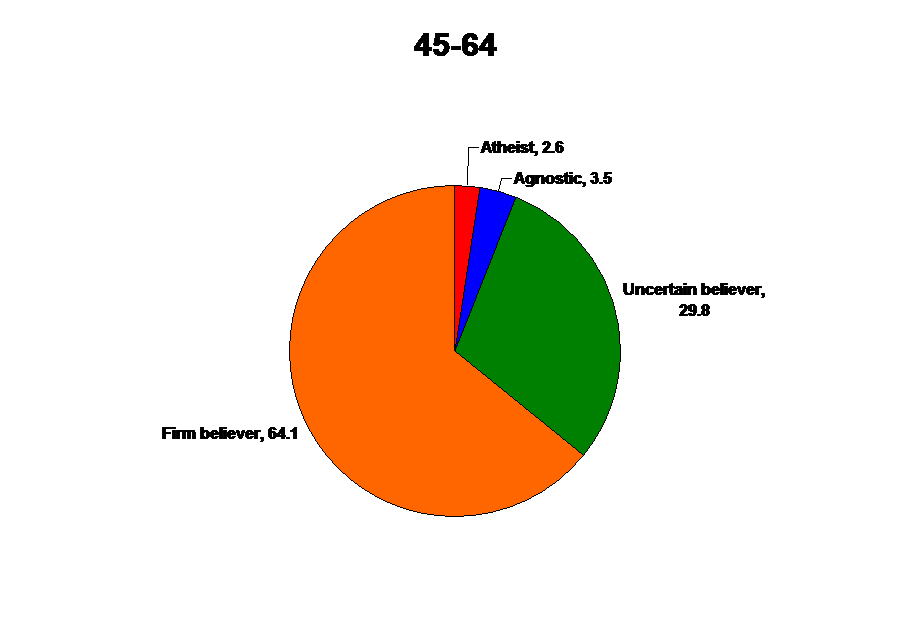
Like children often do, I have many questions. To the GSS I say, "Tell me all your thoughts on God". The following graphs show the percentage distributions for four categories of theistic belief across a host of usual-suspect variables. For contemporary relevance, all results are from 2000 onward. By race:


By sex:

 By political orientation:
By partisan affiliation:


By community type at the age of 16:


By social class:


By age range:


By intelligence*:


By educational attainment:


The quintessential atheist is a high IQ, upper class, urban, white (or Asian), young, liberal Democratic guy with a doctorate. Firm belief is pretty much the norm across the board and a plurality just about anyway one broadly slices it, but the further one moves away from the quintessential atheist, the more theistic things become.

GSS variables used: GOD(1)(2)(3-5)(6), RACECEN1(1)(2)(4-10)(15-16), SEX(1)(2), POLVIEWS(1-3)(4)(5-7), PARTYID(0-2)(3)(4-6), RES16(1-2)(3-4)(5-6), CLASS, AGE(18-29)(30-44)(45-64)(65-89), -WORDSUM(0-3)(4-5)(6)(7-8)(9-10), EDUC(0-11)(12)(13-15)(16-17)(18-20), YEAR(2000-2010)

* For intelligence, respondents are broken up into five categories that come to roughly resemble a normal distribution; Really Smarts (wordsum score of 9-10, comprising 13% of the population), Pretty Smarts (7-8, 26%), Normals (6, 22%), Pretty Dumbs (4-5, 27%), and Real Dumbs (0-3, 12%).

Wednesday, December 5, 2012

Providing procreation predictors, pronto

++Addition++See Jason Malloy's work in the comments.

---

"Have kids" wasn't exactly the right answer to the question of how one finds his way to happy happy village, though "don't have kids" doesn't get the peregrinator any closer, either. But happiness doesn't echo through time, it expires along with its bearer. A question of greater consequence is how we get people to have more (or fewer) children. Okay, it's obvious in a technical sense. But what about a behavioral one?

By way of ordinary least squares, here are the absolute multiple regression coefficients for eleven variables that may reasonably be assumed to have substantial predictive power in terms of realized fertility. For contemporary relevance and to avoid racial confounding, responses are from 2000 onward and only non-Hispanic whites are included. Asterisks indicate statistical significance at 95% confidence.

First, for men, with parenthetical indications of what is associated with greater fecundity:

Marital status -- .37* (marriage = procreation)
Age -- .33* (time = procreation)
Church attendance -- .10* (churchgoing = procreation)
Education -- .07* (less = procreation)
Number of female partners -- .04 (fewer = procreation)
Political orientation -- .03 (conservatism = procreation)
Social class -- .03 (lower = procreation)
IQ (wordsum) -- .01 (intelligence = procreation)
Income -- .01 (less = procreation)
Happiness -- .00 (no relationship)
Belief in God -- .00 (no relationship)

The older a person is, the more time he's had to have kids. Surely age is the strongest predictor of the number of children a man has sired, isn't it? False. Marital status is even more powerful than age is, at least for those with a y-chromosome. Despite rising illegitimacy and declining marriage rates, there is no better* way to get a man to spread his seed than to have him tie the knot. Churchgoing and school-avoiding also push a man towards fatherhood. Nothing else matters much--getting around hurts a smidgen, being conservative helps a bit, but these things only marginally so.

Tangentially, a note to those interested in this sort of stuff: Religious activity tends to be more important than stated religious belief is. Speaking in broad generalities, the man who believes in God but doesn't pray, worship, or otherwise do anything else meaningful as a consequence of that stated belief is behaviorally more similar to an atheist or an agnostic than to a pious person who can reliably be found in the pews on Sunday.

For women:

Age -- .32* (time = procreation)
Marital status -- .24* (marriage = procreation)
Education -- .18* (less = procreation)
Class -- .11* (lower = procreation)
Church attendance -- .07* (churchgoing = procreation)
Political orientation -- .06* (conservatism = procreation)
Belief in God -- .06 (belief = procreation)
IQ (wordsum) -- .04 (stupidity = procreation)
Income -- .02 (less = procreation)
Happiness -- .02 (unhappiness = procreation)
Number of male partners -- .01 (fewer = procreation)

The variables are a more even keel than they are among men, with the only three not mattering much being how much a woman gets around, how happy she is, and how much money she (or her partner) makes. Age is the biggest predictor, followed by marital status, education (a killer of kid creation in the Western world), and then social class, all of which are notably influential.

Affordable family formation (and expressive piety!) isn't just the route to a Republican resurgence, it's the pathway to procreation, too. Societally, of course, we're moving in the opposite direction, as marriage and religious attendance declines while years spent accumulating debt in school instead of creating value in the workforce is still the predominant advice proffered to American youth. Forty more years!

GSS variables used: YEAR(2000-2010), SEX, RACECEN1(1), MARITAL, AGE, EDUC, CLASS, ATTEND, POLVIEWS, GOD, WORDSUM, CONINC, HAPPY, NUMMEN, NUMWOMEN

* With the obligatory qualification that correlation does not necessarily prove causation and is in this context best thought of as merely suggestive.

Monday, November 12, 2012

2012 electoral maps by sex, race, and income

Upon realizing that for cost-cutting reasons there were insufficiently sized exit polling operations carried out in 19 safe states and the District of Columbia, I'd resigned myself to the actualization that it wouldn't be possible to create hypothetical electoral maps based on select demographic characteristics for the 2012 Presidential election. Damn.

But the media consortium didn't conduct detailed polling in the excluded states because they are among the most predictable, and as Steve Sailer has pointed out countless times, people only care about prognosticating about coin tosses. Consequently, with a couple of exceptions that will be noted below, it's obvious how the demographic groupings considered here broke in those states.

Much is made about the gender gap in US politics. While there is a gap more than twice as wide by marital status as there is by sex, the male and female electoral maps look a lot different from one another. Various thinkers on the right have explored how female suffrage has steadily pushed the US leftward. Men and women vote similarly by ancestry, geographic position, and station in life, but the latter are shifted five or six points to the left, movement that is more than enough to tip the scales in one direction or the other in the tight national elections that have been the norm in the country for over a decade now.

First, if only women voted:


Obama wins reelection in an even more convincing fashion than was actually the case, trouncing Romney 347-185 (6 undetermined).

This time, with a little sense and no 19th Amendment:


Under this scenario, Romney wins by nearly the same margin that Obama actually won by.

During the 2008 campaign, Half Sigma doggedly complained that the Sarah Palin wing of the GOP was turning away wealthy, upper class whites who didn't want to be associated with the instincts and concerns of 'prole' whites. Despite the perpetual claims of Republicans being the party of the rich, Obama beat McCain among voters making over $200,000 a year. Romney reversed that in a substantial way, swinging the $200k+ vote 16 points back in the Republican party's favor in 2012. If an income threshold for voting existed, setting it at six figures would be more than enough to give the White House to the Republican party:


Among those making $100k+ annually, Romney obliterates Obama, 372-166. I guess that's a silver lining for guys like HS.

We're repeatedly told how crucial it is for the Republican party to 'reach out' to the one-fourth of the public that is largely hostile towards it at the expense of the nearly three-quarters of the country that more-or-less shares its values and objectives. Knowing that this guarantees the perpetual diminution of the contemporary GOP, those on the left eagerly and disingenuously urge the party to embrace this favorite tactic of the Establishment.

Pandering to and working towards increasing the size of the non-white vote has helped put the Republican party in the spot it now finds itself in, of course. As Ann Coulter puts it, "If Mitt Romney cannot win in this economy, then the tipping point has been reached. We have more takers than makers and it’s over. There is no hope." She dances delicately around the race/ethnicity issue, but she is unique among popular pundits on the right in realizing that there is more to the makers-takers dichotomy than just W-2s.

Before heeding the Establishment's advice and running off the electoral cliff, Republicans should consider how favorable things look for them when the white folk are asked what they think:


Even the two big blue strongholds of California and New York abandon the multiculti party as Romney--compared to Reagan by some boosters during the campaign--enjoys a Reaganesque victory, winning 470-61 (7 undecided). Upping the ante even more, some sense along with revocations of both the 15th and 19th Amendments:


Oh what hideous cartography! Romney wins the electoral college among white men 490-41 (7 undecided). Parenthetically, Rhode Island, one of the states excluded from serious exit polling this time around, gave 48% of it's white male vote to McCain in '08. Given that Romney garnered the support of 62% of white men to McCain's 57%, it's certainly conceivable that Romney won among white guys in Rhode Island this time, but without being able to definitively make that call, I gave it to Obama in the above. If Romney won it, the electoral score becomes 494-37 (7 undecided).

If the US looked like Nebraska, it wouldn't necessarily follow that we'd have a two-party system consisting of a perpetual majority and an ever-defeated opposition. Instead, general election campaigns would be as competitive as they are today. Gauging public sentiment has come a long, long way from Dewey beats Truman, and campaigns on both sides are able to calibrate the message precisely enough to reliably get, at a minimum, say 45% of the vote. The difference would be that general elections would look like Republican primaries do now, and the typical Republican primary would resemble a debate between Sailer, Auster, Buchanan, Barone, Raimondo, and Reynolds. The demographic transformation the US is currently undergoing is driving a stake through the heart of political conservatism. Indeed, we are doomed.

With all this reclinating back towards the good 'ole days, it feels like we're forgetting something far more relevant for the future. How does the electoral map look when we consider non-whites exclusively? Well, despite representing the driving force behind the nation's demographic changes, it looks exactly the same as it did in 2008. Rather than recreate it here, I'll just ask you to take a look at the original.
ban nha mat pho ha noi bán nhà mặt phố hà nội