RSS
Facebook
Twitter

Showing posts with label Media. Show all posts

Thursday, December 12, 2013

Facebook and Twitter, lion and leopard

Find them on Facebook and Twitter!--as if these two are the Coke and the Pepsi of the social networking world. More like the Coke and the 7UP, actually. Google trends on searches for the terms "facebook" and "twitter", respectively, with "youtube" added in for additional perspective:


Over half of all US adults have Facebook accounts. By contrast, just 1-in-9 use Twitter.

Perhaps Twitter is the new Facebook? Twitter is seven years old. In human years, that constitutes youth. The virtual world's aging process has more in common with dog years, though. Twitter isn't novel.

Facebook's IPO was underwhelming (for outside investors, not so much for the company itself). Twitter's was great (for those looking in from the outside; the company left billions on the table). Twitter, however, doesn't have a larger market presence as a consequence. To the contrary, Facebook's market cap is more than four times Twitter's.

Twitter isn't a high-brow version of the proletariat's Facebook, either. From Pew Research last year:


Heavily urban, heavily NAM. Twitter is certainly hip. And it's convenient for lazy, cash-strapped media outlets that are able to replace something approaching actual journalism by simply copying a celebrity's half-sentence tweet and passing it off as newsworthy.

What else should be expected from a platform with such space constraints that users might as well be limited to rap's contemporary lexicon, though?

Pew doesn't break down the racial characteristics of Facebook users, but unlike Twitter, Facebook usage increases with education and income, so it's presumably icier than Twitter's sunny profile.

To Twitter's tweeting there is Facebook's essentially identical status updating. To Twitter's re-tweeting there is Facebook's essentially identically sharing. That basically summarizes everything Twitter does. As noted, Facebook does the same (with wider reach), but only in addition to about a bazillion other things to help its far more numerous users navel gaze or whittle time away candy crushing it.

Parenthetical disclosure: I have no employment or shareholder connections to either company, I find Mark Zuckerberg's open borders advocacy more obnoxious than Jack Dorsey's standard but not especially agitating SWPL tendencies, and I have user accounts on both sites.

Saturday, November 16, 2013

Professional journalism

On display in that oh-so venerable rag, the New York Times, in an article referenced recently by Steve Sailer. Excerpt worthy of special derision, my emphasis:
In a photograph taken not long after the assassination, my grandmother smiles a porcelain smile, poised and lovely in psychedelic purple Pucci, coiffure stacked high in what can only be described as a hairway to heaven.
Only? It can only be described using a cute phrase that doesn't even denote a specific hairstyle, but is instead used in local hair styling salons all across flyover country? There is no other way to describe it?

Wednesday, October 16, 2013

Listening to a story on NPR's The World about the US citizenship exam got me wondering on what things involving human membership is the left more discriminating (in the older sense of the word) than the right is:
One of the more obscure questions, she said, includes questions like “Who wrote the Federalist Papers?” 
“Most Americans could not answer the question, so I'm not sure why it's on the test,” she says.  
 Winke has found that US citizens only outperform immigrants on local governance questions, such as, “Who is your House Representative?”  
 “From a test development standpoint, then you start wondering what is this test testing?” Winke says.
There is little inherent value placed on citizenship in this line of reasoning. Citizenship is thought of as a right rather than as a privilege, and certainly not something that should be leveraged for the well being of those who are already citizens.

The citizenist (or political conservative, more generally), in contrast, reasons that given that the value of US citizenship is estimated to be 'worth'* nearly $15,000 per year , a one-time expenditure of $600 for a test of rote memorization (and only 100 potential questions to commit to memory--even with no prior knowledge of American civics or history, it's easy to comprehend the test's 92% pass rate) seems like the deal of the millennium. There are considerations beyond the economic that come into play as well, of course, such as cultural compatibility, language fluency, social harmony, etc.

Anyway, whether it be same-sex marriage, the Augusta country club, women in combat, felons (and felonious!) voting, illegal immigrants being granted citizenship, fat acceptance, dumbing down testing standards, or employing racial quotas, the contemporary left can almost always be defined by a lack of any standards. Exclusion is a great evil, even though the most vociferous opponents of exclusionism tend to be quite exclusive in their own lives. Yet on some issues--environmental ones immediately come to mind--the left dispenses with philosophical concerns about exclusion. What are some others? Exclusion from life in the case of abortion, I suppose, though that might be too emotionally charged to come to a consensus on. Maybe re-designation, too, but because the desire to do so is more attractive to the left and consequently those on the left are the ones who do it, it's ambiguous.

Parenthetically, it's easy to argue that things like racial quotas are zero sum and consequently neither inclusive nor exclusive, but instead merely a version of Cassius' most famous line, more easily (and thus less discriminatingly!) understood by the phrase "Who? Whom?". But while uncomfortable dissonance is a consequence of what the left preaches and how it behaves, I'm not cynical enough to attribute the entire broad philosophical outlook to a complex set of triple bank shots--they're mostly sincere in their instincts, at least as sincere as the religious believer is in the power of the supernatural.

* In reality, comparing the Derbs and the guys riding together in conversion vans to solicit work in Home Depot parking lots with one another is not an apples-to-apples comparison, but the point remains that even though there are lots of illegal immigrants in the US who don't care about obtaining citizenship, among the millions and millions of non-citizens who do, there are lots who would pay more than $600 for it.

Sunday, September 29, 2013

Cartels vs. Insider Trading

Steve Sailer writes:
I'm interested in the topic of cartels and price-fixing, in large part because nobody else seems to be interested in them, which reflects a massive change from as recently as the 1970s.
As an early millennial, I remember hearing a bit about the topics in a college macroeconomics class, but that was about it. I do recall a seemingly inordinate amount of focus on insider trading. The latter is a sexier subject because of the soap opera intrigue and bigger-they-are, harder-they-fall story lines it presents media types with, but in terms of inefficiencies and dead weight losses to the larger economy, the former must be more substantial by orders of magnitude.

Google's Ngram viewer, which tracks incidents of words, terms, and phrases in books over time, reveals:


Steve nails it (surprise, surprise).

Anecdotally but germanely, I've come across two separate stories today on Mark Cuban's alleged insider trading a decade ago that is said to have netted him $750,000, but this is the first I've heard of an auto-parts price rigging operation with a price tag at least 1,000 times as large.

Thursday, July 18, 2013

It's been impossible not to notice the visceral negative reactions among leftists on social media sites and the like to the recent Rolling Stone cover showing the younger tax-eating terrorist from crapistan who helped set off bombs in Boston. We're talking about marathons in Massachusetts, not skeet shooting in Chattanooga--SWPLs were really upset by the bombings. There just isn't much sympathy for the devil on display for this one. Portraying one of the instigators in such a way was bound to garner a lot of attention, but then again car crashes garner a lot of attention, too, but they're usually not good for the drivers.

Sure, there is perspicacity in the observation that some women are attracted to killers and the attention they receive for being identified as such, and the crapistani is no exception. But let's not lose perspective here--for every one girl who wants his nuts, there are hundreds or thousands who would like to put them in a vise. And in fairness to the ladies, if Nina Dobrev's doppelganger did something this nefarious, how many men would masturbate with her in their heads as they read about and watched the subsequent trial unfold? Because we're sophisticated enough to separate love from lust, though, we'd still be fine with having her hang from a lamppost after we were through with her, unlike the crapistani's aspirants, who would like to spend their energy trying to domesticate him instead! Really, before it becomes ancient history to them, ask some female SWPLs about the punk. The reaction is similar to what you'll get if you ask them about Fred Phelps.

For pundits on the mainstream right (that excludes darkly enlightened, red-pill popping HBDers, of course), this should signal the start of a field day. For one, the incident itself is exactly what the polite right opposed to amnesty and open borders dreams about--terrorist activity committed by a white (nothing racist about our anti-amnesty position!) immigrant who was given the green light to stay in country and then subsequently given naturalized citizenship, both far too easily, who targeted an event leftists love in a city leftists love. Moreover, an iconic, cultural standard-bearer for the degenerate baby-boomer leftist worldview not only lines up on the wrong side of the issue, but is perceived as glamorizing evil incarnate in the process.

Parenthetically, I realize the article isn't hagiographic, but in a world where attention spans max out at around 140 characters, few people are going to get that far, and media types like the editors of RS know this, so that's a risible defense.

Tuesday, August 14, 2012

That'll Costa

The skill set required for successfully conducting broadcast public interviews is not a relevant one for most people to have. But for those who are in the business, I wonder if there are any protocols, spoken or unspoken, against giving distracting verbal cues to show that, I guess, as the interviewer, you are indeed listening to the person you're interviewing.

Rebecca Costa demonstrates what I mean only too well. Scroll down to the interview with John Ross (12/17/10) and listen to the 40 seconds from 40:40-41:20. Notice (which will be an easy thing to do--the challenge would be to not notice) the five "uh huhs" Costa utters. I happened to check the media player during that time period, but it's something she does with great frequency. Richard Spencer also does it to the point of distraction.

I understand that non-words are a difficult thing for people to cut out of their speech patterns and I don't mean to be acerbic in drawing attention to it. But in these cases, it simply requires one person to be quiet while the other person is speaking. With minimal effort, it would presumably be an easy and beneficial thing to do.

Saturday, March 3, 2012

Right to privacy, Facebook variety

A Pew survey on the online social networking habits of adults reveals unsurprising gender differences in personal privacy settings. By a ratio of nearly 5 to 1 (67% to 14%), women make their profiles private and thus only accessible to their friends rather than making them publicly available for viewing by whoever looks them up. While men also tend towards restricting profile access, the ratio, at less than 2 to 1 (48% to 26%), is far less lopsided.

Biology is informative here. Women are the more restrictive gender not only in regards to sex, but when it comes to personal relationships of lesser intensity as well. The survey didn't probe it, but I'd wager girls are also more apt to reject friendship requests from people they barely know or don't know at all than guys are. Being Facebook stalked is understandably a worrisome issue for women, while for men it's flattering and invitational (there are a few easy tricks to get a good sense of who is regularly checking your Facebook profile out).

Parenthetically, 93% of those who use online social networking sites have a Facebook account (as of Spring 2011). MySpace is still used by 23% of them. By contrast, only 11% use Twitter. It's my impression that the latter receives undue media attention given its relatively niche presence. I don't use Twitter so excuse my ignorance about the site, but doesn't Facebook, via status updates, do everything Twitter does plus a whole lot more?

Saturday, September 24, 2011

Homo nest invaded

In an interesting article on Obama's "evolving" position on same-sex marriage, Jack Cashill describes how the progressive left's feelings towards homosexuals has similarly evolved since the Stonewall Riots that putatively got the gay ball rolling. The New York Daily News, providing me with yet another example* of why it can be so much fun to revel in print media from the past before the vise of political correctness had become as suffocatingly tight as it is today, headlined the incident "Homo Nest Invaded, Queen Bees are Stinging Mad". The Village Voice called it the "Great Faggot Rebellion".

I have a hazy conception of the gay rights movement coming a couple of decades after the civil rights movement, sometime during the eighties as AIDS exploded onto the scene and provided homosexuals with the perfect vehicle to ride to Victimhood. People my grandparents' age do not show sufficient sensitivity to the concerns of either Negroes or sodomites. People my parents' age are better when it comes to blacks and Hispanics, but they don't take queers seriously enough. My generation treats African-Americans, Latinos, gays, and lesbians with more civility. Even we still have a long way to go though, of course!

So when did gay rights enter the American lexicon? Google's Ngram viewer gives some idea:


The phrase was almost non-existent until the late sixties (the Stonewall Riots occurred in 1969). It blew up in the mid-eighties before periodically cresting a decade later at the time the Defense of Marriage Act was enacted. After descending a bit, its ascent has resumed. With the legalization of same-sex marriage across much of the US a seeming inevitability sometime in the near future, the growth trend will likely continue.

* My dad, who is a professor of marketing, collects magazines and newspapers from 40s, 50s, and 60s. Flipping through them always brings a chuckle, albeit one tainted by melancholy. Aw, the way we was.

Sunday, August 28, 2011

AE in the WSJ

... via an op/ed (fourth paragraph, referencing this post) by City Journal editor, author, and Manhattan Institute senior fellow Steven Malanga on the disconnect between the leftist advocacy and financing provided by union leadership and the sentiments of far more centrist due-paying, rank-and-file union members.

Monday, April 18, 2011

Hello Helen

Pew recently released the results from the March 2011 News IQ quiz, a series of 11 multiple choice questions concerning current events given to a random sample of ~1,000 US adults. Previously, I posted on how men consistently outperform women on this quiz, and the most recent survey was no exception to this rule. I've updated the original post accordingly.

The one question women fared better than men on concerned No Child Left Behind legislation. The Simpsons got it right in electing to give the "Won't somebody please think of the children?" catchphrase to a female character.

Thursday, April 7, 2011

Cletus is such a throwback

Syncretism makes three suggestions for Ngrams. When I was in middle school, I remember my older cousin's reaction when watching an episode of The Simpsons where Cletus returns a pair of boots to a telephone pole where he found them and says, "Back you go, to wait for a woman of less discriminating taste." My cousin burst out laughing. I didn't appreciate at the time that Cletus was revealing the high regard he held for his girlfriend, thinking instead that he was insulting her for being a shoe racist or something. Recalling that, I included "discriminating" alongside "discrimination", to capture the transformation of the word from complimentary adjective, which implied perspicacious discernment, into its present form as the wicked noun, found in the hearts of acrimonious, mean-spirited souls (click on each image for higher resolution):


The identification of the hate crime, a revolutionary advance in criminal justice, came about in the late eighties. And not a moment too soon, as it finally gave law enforcement an effective way to prosecute people for assault and homicide. Despite being told that racism has been around since at least the age of colonization, it actually sprung up during the sixties. Who would have thought?

Tuesday, March 22, 2011

Countries American authors write about

The blog post where Agnostic looked at how much attention the New York Times (a reasonable measure of the pulse of the major American media more generally) devoted to countries around around the world as a means of, among other things, allowing for some perspective on US foreign policy is among my favorite.

I've wanted to do something similar but covering a much longer time horizon using Google's Ngrams, but once you go beyond eight or so items in a single line graph, it quickly degenerates into an aesthetically displeasing cluster.

So instead, I captured the last 208 years of American literary history of what constitutes the 50 countries I'd guess Americans would be most likely to jot down if asked to write the first 50 that came to their minds. It's an arbitrary selection, but there are places like Bhutan and Saint Kitts that are simply meaningless to most people. The y-axis is auto-fitted to the entire range over the last two centuries, so inter-country comparisons are relative, not absolute.

Parenthetically, one nice feature of Ngrams is that searches are case sensitive, so while some countries like Turkey conceivably are over counted a bit in some years if a book contained a sentence starting with the regular noun "turkey", this is essentially a non-issue.

France:

England:

Ireland:

Holland (the Netherlands):

Germany:

Portugal:

Italy:

Spain:

Russia (Soviet Union):

Switzerland:

Sweden:

Poland:

Europe:

The Old Continent doesn't loom as large as it used to. A tale of two cities no longer, as thinking about who Americans should have greater affinity for, the English or the French, is about as antiquated as the debates between federalists and anti-federalists are. Russia was a big deal as the Bolsheviks took over and the Soviet Union started making headway. As the latter fell apart, its mother country followed a real-life decline paralleling that of its decline in importance from an American perspective. Switzerland, true to its notorious neutrality, scoots along horizontally minding its own business. The immigrant waves from Poland and Germany show up, but like the rest of Europe, it's all downhill in the 20th century.

Australia:

New Zealand:

United States:

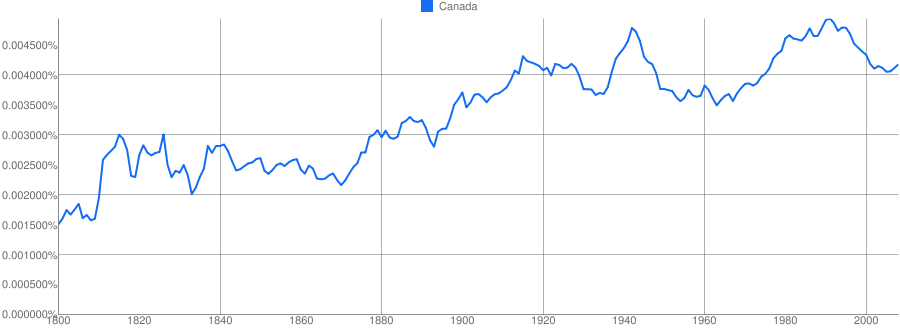
Canada:


Hello Anglosphere! I assume increased globalization brought first world nations surrounded by the third world into greater focus among those in the US accustomed to paying the most attention to Western European. As the world 'shrank', I guess Australia moved into throwing distance, just like England and Germany had, uh, been all along!

China:

Japan:

Korea:

The Philippines:

India:

Pakistan:

Afghanistan:

Vietnam:

Thailand:

Asia:

Vietnam and Afghanistan would rank alongside Laos and the rest of the crapistans, respectively, if we hadn't gone into those countries, spent lots of time, blood, and money killing the bad guys, and planted the seeds of freedom that sprouted into the dynamic, modern, liberal nations that Vietnam and especially Afghanistan are today.

We pay attention to explosive growth as (South) Korea and Thailand demonstrate, but sort of lose interest after a country on the ascent peaks and then starts sliding downwards (see Japan). Hu Jintao is a pretty big deal, but he still yet to get out from underneath Mao's shadow.

South Africa:

Angola:

Zimbabwe:

The Congo:

Ethiopia:

The Sudan:

Somalia:

Kenya:

Madagascar:

Africa:


In the 1960s, Americans met their father's poor mistress for the first time (Ethiopia and Madagascar don't count, as they're not genuinely African!) and realized that though they'd been estranged for a few centuries, the Dark Continent was the United States' other parent continent. Some parts of Africa were just too depressing to pay attention to for long, but others, like South Africa, the Congo, and Zimbabwe captured the popular imagination when they overthrew their oppressors and through self-determination allowed themselves to become the flourishing nations they are today!

Mexico:

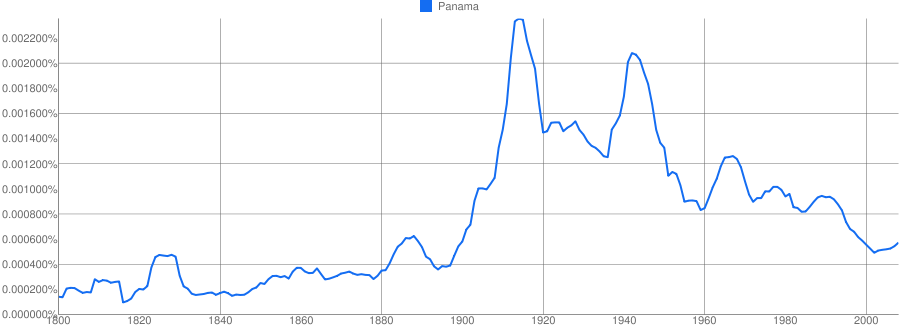
Panama:

Cuba:

Venezuela:

Brazil:

Peru:

Argentina:

Chile:


You might think we'd be paying more attention to South America as it creeps northward, but you'd be wrong. The canal is fine. What more do you want to know?

Egypt:

Lebanon:

Syria:

Iraq (Mesopotamia):

Turkey:

Israel:

Saudi Arabia:

Iran (Persia):


The places that have little direct influence on the flow of oil, like Egypt and Syria (yes, they both produce about enough to provide for themselves, and there is the Suez applies, but they aren't Saudi Arabia!), mattered a lot more when our ancestors were in control of them than they do now. Today we only tune in (and get giddy) when their pious throwback populations overthrow their relatively secular, friendly rulers because we're masochists. Or when neocons alert us to the threat of a rising superpower bent on Isra-, er, our destruction.
ban nha mat pho ha noi bán nhà mặt phố hà nội