RSS
Facebook
Twitter

Showing posts with label Economy. Show all posts

Sunday, September 29, 2013

Cartels vs. Insider Trading

Steve Sailer writes:
I'm interested in the topic of cartels and price-fixing, in large part because nobody else seems to be interested in them, which reflects a massive change from as recently as the 1970s.
As an early millennial, I remember hearing a bit about the topics in a college macroeconomics class, but that was about it. I do recall a seemingly inordinate amount of focus on insider trading. The latter is a sexier subject because of the soap opera intrigue and bigger-they-are, harder-they-fall story lines it presents media types with, but in terms of inefficiencies and dead weight losses to the larger economy, the former must be more substantial by orders of magnitude.

Google's Ngram viewer, which tracks incidents of words, terms, and phrases in books over time, reveals:
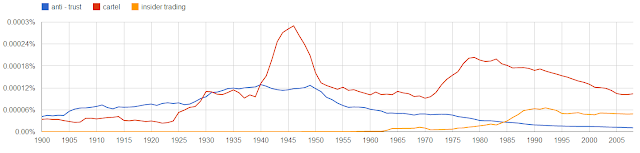

Steve nails it (surprise, surprise).

Anecdotally but germanely, I've come across two separate stories today on Mark Cuban's alleged insider trading a decade ago that is said to have netted him $750,000, but this is the first I've heard of an auto-parts price rigging operation with a price tag at least 1,000 times as large.

Saturday, February 9, 2013

The service economy

I remember hearing in junior high and high school a fair amount about how the US had become a "service economy" and that the provision of services had replaced the provision of goods as the marker of a country's affluence; in college, I recall a handful of passing references being made; contemporaneously, I can't think of a time in the last five years that I've heard a reference to the service economy being made. From Google's Ngram viewer, the percentage of books published in the US that have contained the phrase, from 1960 through 2008:


I fear that professing to your neighbor's kids about Mexican feminism so that he'll do your taxes so you can use your refund to have your other neighbor adjust your lower spine so that you're comfortable when you sit down with your financial adviser to discuss your targeted retirement account isn't as surefire a way to national riches as we once assumed it was.

Tuesday, March 1, 2011

Argue over whether or not reparation payments are owed to blacks by the descendants of whites who brought the ancestors of these blacks to a country where today they enjoy more than ten times the purchasing power of their cousins back in sub-Saharan Africa? That debate is taking place in states like Wisconsin, Indiana, and Ohio right now.

Pew Research released a survey in which respondents were queried on whether they supported Wisconsin public sector unions or the state's governor, Scott Walker, in the dispute over the collective bargaining rights of the former. Among whites, support for the unions and for Walker are at parity (38% to 36%, respectively). Among non-whites, though, it's a different story. The unions are backed by 51% of non-whites, while only 19% support Walker.

Parenthetically, I was vaguely under the impression that support for unions would mirror their presence in the workforce over time. Consequently, I would've guessed that older folks would be more inclined to back the unions than the twenty-somethings who are having an especially difficult time finding teaching jobs and the like because of union protections that allow existing costly and tenured public sector workers to comfortably remain on their jobs.

Nope. Among those aged 18-29, 46% back the unions compared to only 13% standing behind Walker. For those aged 65 and over, Walker actually wins, 45% to 33%.

In his most recent podcast, the Derb solemnly warned the American public that economic ruin looms unavoidably on the horizon (see item #8):
What is most likely to happen in the near future is that the present feeble recovery will stall and we shall slip into another recession, with the deficit still unsustainably huge. There will then be no prospect of stimulus or bail-outs. The U.S. government will perforce respond to that next recession not by increasing spending, but by cutting it.

That's the right thing to do for long-term improvement; but in the short term, with the debt overhang already humongous, it will leave the economy dead in the water. Even the feeble, unconvincing recovery we've gotten as a result of the last two years' spend-o-rama won't be possible.

In that situation, investor confidence will at last collapse. The markets will dump our sovereign debt, and the only way — absolutely the only way — for the feds to meet their domestic obligations will be by massive and sustained inflation. Your savings will become worthless, a gallon of gasoline will cost $500, and your city police and fire services will be laid off.

Bottom line: Get in lots of canned food, bottled water, and ammo. It's going to be very bad. I don't see any way out. This is serious; I'm not kidding.
As someone of a generally optimistic disposition, I want to shrug this sort of disaster auguring off as hyperbolic apocalyptic porn. But that just keeps becoming more and more difficult to do.

Sunday, February 28, 2010

Illegal immigration and unemployment

In the comments from the previous post, blogger Robert Wiblin contested my presumption that unskilled immigration raises the native unemployment rate. We may be talking past one another, as he provided links to studies finding small decreases in unemployment from increased levels of overall immigration. Given the inherent difficulty in tracking illegal immigrants, these studies probably disproportionately attempt to gauge the relationship between legal--rather than total--immigration and unemployment levels. To the extent that the two correlate positively over time, though, it's a chicken-and-egg question: Do immigrants decide for whatever reason to come to an area and subsequently engage in entrepreneurial activities that lead to a net increase in that area's overall employment rate, or does a growing area in need of laborers and professionals attract immigrants to it?

The number of controls and assumptions necessary to tease out the stand-alone effect of immigration--never mind the challenges presented in trying to separate EB-5 immigrants from the MS-13 variety--is daunting, with the outcome contingent upon what controls and assumptions are made.

As my remarks concerned illegal immigrants in the US, who are largely unskilled, it seems reasonable to consider the simple relationship between the percentage of a state's total population comprised of illegal immigrants (see p12) and that state's unemployment rate. Using the latest data available, the two correlate at a moderate .33 (p=.02, two-tailed)--that is, states where illegal immigrants constitute a larger share of the population are states where the current unemployment rate tends to be higher.

Michigan, home to Ford, GM, and what's left of Chrysler, suffers the nation's highest unemployment rate (14.6%), but has few illegal immigrants. Removing it from the analysis boosts the correlation to .41 (p=.00, two-tailed).

This, of course, does not prove causality. But it does make it tougher to accept the assertion that higher levels of illegal immigration lead to lower levels of unemployment, when it is higher levels of unemployment that are associated with higher levels of illegal immigration in the US.

Wednesday, February 10, 2010

If you build them...

From the WSJ's What's News section:
Home builder are ramping up speculative construction to attract last-minute buyers who want to tap a soon-to-expire tax credit [the purchase must be signed by April 30 and closed on by June 30].
Houses were being built with reckless abandon a few short years ago, and times were good then. Clearly, we need the relentless construction to resume. Never mind that 2009 was yet another record year for home foreclosure filings:
Almost 3 million homeowners received at least one foreclosure filing during 2009, setting a new record for the number of people falling behind on their mortgage payments.

RealtyTrac, the online marketer of foreclosed homes, reported that one in 45 households -- or 2,824,674 properties nationwide -- were in default last year. That's 21% more than in 2008, and more than double 2007's total.

The dramatic, sustained increase occurred despite efforts, such as President Obama's Home Affordable Modification Program, to reduce foreclosure filings.

This will lead to the adjustments needed in the larger economy to purge malinvestment and direct resources to the most efficient uses possible. Government intervention into the market always has that effect, after all.
ban nha mat pho ha noi bán nhà mặt phố hà nội