RSS
Facebook
Twitter

Showing posts with label Politics. Show all posts

Saturday, November 9, 2013

Virginia tells

As one of the most demographically representative states in the country, and one with an enormous amount of American history packed into it to boot, the gubernatorial results out of Virginia this week are worth examining as a way of better understanding America's contemporary social landscape.

- Cuccinelli, the Republican, won among whites by a margin (56%-36%) nearly identical to the margin Romney did in the 2012 presidential election (59%-39%). McAullife, the Democrat, similarly won among blacks (90%-8% compared to Obama's 93%-6%). No surprises here. At 72% of the Virginia electorate and shrinking, it is difficult for Republicans to win nationally representative elections without winning 2-to-1 among whites. The exit polling data do not report results for other groups due to insufficient sample size, but it's safe to assume McAullife won among the Hispanic/Asian/other residual about as convincingly as Obama did last year.

- Despite all the political polarization etc etc, the third party pipe dream is becoming less and less tenable as the US becomes less and less non-Hispanic white. Whites are the only people with whom Kang's famous taunt to (or was it Kodos'?) "go ahead, throw your vote away", actually resonates. Sarvis, the libertarian, got over 87% of his votes from whites. Cuccinelli received a strikingly similar share of his total votes from whites, coming in at just under 89%. McAullife, in contrast, received just over half of his votes (54%) from whites. Perhaps the seemingly disparate Democratic coalition breaks apart at some point in the future, but currently whites are the only ones who appear to have any willingness to oppose it.

- Why I think Rand Paul's liberty message has legs to stand on in the future: Sarvis' won nearly 15% of voters under age 30 but less than 6% of those aged 30 and over. Whether or not this is constitutes the making of a deal with the devil, reasonable people will disagree.

- The fat-cats-versus-working-class-union-types dichotomy became antiquated decades ago, not least because of the spending advantage Democrats now regularly enjoy, this election clearly being no exception. The new paradigm pits the top and the bottom in alliance against the middle:


Though he lost the race, Cuccinelli won comfortably among voters in households with annual incomes in the $50k-$100k range, and held his own in the $30k-$50k and $100k-$200k ranges, but was blown out by McAullife both among those earning less than $30k and among those making $200k+.

- Another way to characterize today's political dynamic is to pit the government trough eaters and trough fillers against the government food trough producers, or value transferers vs. value creators. Without the state's DC suburbs, from which almost 1-in-5 voters hailed from, Cuccinelli would've won by nearly the same margin he ended up losing by.

- While arguing that there should be some sort of property ownership requirement as a prerequisite to voting eligibility will figuratively lead to one being tarred-and-feathered to shouts of "no to Jim Crow!", the exit polls offer a more modest tact to take in opposition to universal suffrage, of a less personal nature than that preferred by Howard Stern, but similarly based.

Queried on whether Cuccinelli's positions--fairly described as strongly socially conservative within the parameters of contemporary American politics--were too liberal, too conservative, or just right, 8% of exit poll respondents answered "too liberal". Among this group comprising 8% of the electorate, 77% voted for McAullife! The actions of the 13% who said he was too liberal but still voted for him and to a lesser extent the 9% who said the same while voting for Sarvis are comprehensible, but the only conclusion regarding the vast majority who voted for McAuliffe because Cuccinelli is too liberal is that they simply have no idea what "liberal" or "conservative" means in a political context! These are people who would garner a goose egg (okay, it's multiple choice, but you get the idea) on Pew's Political News IQ test, unable to name the vice president or say which party controls the Senate.

Let's not be too critical of this contingent of utterly clueless voters, though. Chances are, they are quite a vibrantly diverse and diversely vibrant crowd and consequently worthy of reverence (even if--or perhaps especially because!--they come almost exclusively from the bottom part of that top-and-bottom alliance we spoke of earlier).

The reverse probably occurred as well, as there were inevitably a few Cuccinelli voters who said McAullife was "too conservative", but their numbers were too small to be statistically reliable and thus were not reported on.

Wednesday, October 16, 2013

Listening to a story on NPR's The World about the US citizenship exam got me wondering on what things involving human membership is the left more discriminating (in the older sense of the word) than the right is:
One of the more obscure questions, she said, includes questions like “Who wrote the Federalist Papers?” 
“Most Americans could not answer the question, so I'm not sure why it's on the test,” she says.  
 Winke has found that US citizens only outperform immigrants on local governance questions, such as, “Who is your House Representative?”  
 “From a test development standpoint, then you start wondering what is this test testing?” Winke says.
There is little inherent value placed on citizenship in this line of reasoning. Citizenship is thought of as a right rather than as a privilege, and certainly not something that should be leveraged for the well being of those who are already citizens.

The citizenist (or political conservative, more generally), in contrast, reasons that given that the value of US citizenship is estimated to be 'worth'* nearly $15,000 per year , a one-time expenditure of $600 for a test of rote memorization (and only 100 potential questions to commit to memory--even with no prior knowledge of American civics or history, it's easy to comprehend the test's 92% pass rate) seems like the deal of the millennium. There are considerations beyond the economic that come into play as well, of course, such as cultural compatibility, language fluency, social harmony, etc.

Anyway, whether it be same-sex marriage, the Augusta country club, women in combat, felons (and felonious!) voting, illegal immigrants being granted citizenship, fat acceptance, dumbing down testing standards, or employing racial quotas, the contemporary left can almost always be defined by a lack of any standards. Exclusion is a great evil, even though the most vociferous opponents of exclusionism tend to be quite exclusive in their own lives. Yet on some issues--environmental ones immediately come to mind--the left dispenses with philosophical concerns about exclusion. What are some others? Exclusion from life in the case of abortion, I suppose, though that might be too emotionally charged to come to a consensus on. Maybe re-designation, too, but because the desire to do so is more attractive to the left and consequently those on the left are the ones who do it, it's ambiguous.

Parenthetically, it's easy to argue that things like racial quotas are zero sum and consequently neither inclusive nor exclusive, but instead merely a version of Cassius' most famous line, more easily (and thus less discriminatingly!) understood by the phrase "Who? Whom?". But while uncomfortable dissonance is a consequence of what the left preaches and how it behaves, I'm not cynical enough to attribute the entire broad philosophical outlook to a complex set of triple bank shots--they're mostly sincere in their instincts, at least as sincere as the religious believer is in the power of the supernatural.

* In reality, comparing the Derbs and the guys riding together in conversion vans to solicit work in Home Depot parking lots with one another is not an apples-to-apples comparison, but the point remains that even though there are lots of illegal immigrants in the US who don't care about obtaining citizenship, among the millions and millions of non-citizens who do, there are lots who would pay more than $600 for it.

Saturday, October 12, 2013

Although the 2012 GSS did not include any questions on presidential voting plans for the same year, the survey did sneak in a question on presidential approval, querying respondents on whether they approve or disapprove of the way Barack Obama is handling the job of president. Because it's fun and often causes people to make fools of themselves, here are IQ estimates derived from wordsum scores for those approving and disapproving of Obama's performance, presuming an average national IQ of 98 and a standard deviation of 15:

Approve -- 97.7
Disapprove -- 98.5

A nation divided. Race, of course, is a confounding factor. When only non-Hispanic whites are considered:

Approve -- 101.5
Disapprove -- 99.3

Per usual, white leftists could appear more credible in the supercilious scorn they have for their bigoted brethren if they acknowledged as much. Since they're afraid to do so, however, let it be known that Obama's supporters aren't quite as intelligent as his detractors are!

More insightfully, the GSS results provide a useful illustration of what the Derb terms "classic class conflict: the top and the bottom against the middle". The following graph shows Obama's approval/disapproval numbers among members of five categories in which respondents are classified based on their wordsum scores*:


If only I could remain stuck in the middle with you. Unfortunately, stasis appears to be a dream of the past, not the way of the future.

GSS variables used: PRESPOP, WORDSUM(0-3)(4-5)(6)(7-8)(9-10), RACECEN1(1)

* Respondents are broken up into five categories that come to roughly resemble a normal distribution; Really Smarts (wordsum score of 9-10, comprising 13% of the population), Pretty Smarts (7-8, 26%), Normals (6, 22%), Pretty Dumbs (4-5, 27%), and Real Dumbs (0-3, 12%).

Thursday, October 3, 2013

Endovelicus

Granting the general political ineptitude of Republican pols and the continual creep of executive power at the expense of congressional restraint, why isn't the riposte to the assertion that the 2012 presidential election was a referendum on Obamacare that the GOP won the house? Every congressional district in the country had an election on the same night, and Republicans came out 33 bodies ahead, the vast majority of the victors having incorporated opposition to Obamacare as part of their campaign platforms (is there a single one who did not?).

Obamacare was passed by a Democratically-controlled House and Senate, but by the time the question of funding had come around, the public's dissatisfaction with the law had served as a catalyst for a return to divided government. The stupid party would be able to strike an oh so sought after moderate pose by claiming that the American people are divided on the question, and consequently the law should be put to a national referendum, or, in a more republican style, people should be allowed to opt out entirely for the first year or something similar.

I'd love a red pill review of Obamacare, and of the state of health care in the US more generally (this is a solicitation--please feel free to oblige in the comments). Much like our mutually exclusive national ideals of liberty and equality, our simultaneous insistence upon providing everyone access to the best health care available and also on making health care affordable for all tells me the whole enterprise is hopelessly saturated in a thick paste of contradictory, quixotic nonsense that conceals the perpetual, mendacious special interest plundering that is taking place on the inside.

I attempt to take a citizenist perspective on the issues of the day, but I scarcely feel like I can make out the top letter of the chart when it comes to this byzantine subject. Thus handicapped, I'm reduced to free market utilitarian analogies and firsthand experiences. Regarding the former, imagine how expensive and inefficient auto insurance, care, and usage would be if insurance companies footed the bill for every driver's flat tire, fuel up, and rim upgrade, or, even more profligately, if private auto insurance was abolished and instead all a person had to do was provide a driver's license to have these services performed, or if a home insurance provider was required to indiscriminately sell a home insurance policy to a home owner whose house had just burned down.

As far as personal experience goes, the head of my company's benefits department has earnestly told me that if one of our employees requests reimbursement for a pack of condoms, the affordable care act requires us to pay up. With a doc in the box that completely covers me and my family without my having to (directly!) pay a dime, I'm sensitive to concerns over--outright hostility to, really--the law's implementation among our corporate brain trust. I've been fortunate not to have ever fallen ill in the decade I've been an employee, but with a baby on the way, I've finally started trying to get to work on some long overdue homework.

Other questions linger. Will other companies follow the lead of Walgreens, UPS, and IBM and begin dumping their employees onto the public exchanges in the future, bringing about an effective socialization of health care in the US? Will the seemingly inexorable trend away from a national norm of working for a living necessitate the separation of health insurance and employment?

Wednesday, July 3, 2013

Pedant on that

In summarizing a post on college bank rollers, Steve writes:
In general, it appears that the biggest donors to colleges are conservatives.
To investigate this assertion rigorously would require something akin to Fortune's survey of the XXX wealthiest whatevers. The groups in question are too numerically small to be represented with any meaningful reliability in most wide-ranging, general surveys. Sometimes these surveys employ precision modules targeting niche respondent groups, but the results are often fruitless (and risible to boot). Case in point, the 2012 GSS includes a set of items pertaining to elements of Jewish identity. It garners relevant responses from a whopping 12 people. Hardly enough for a HBR case study, let alone statistical significance on a national scale. This isn't an isolated example, either.

While general surveys aren't capable of providing the electrolytes number crunchers crave, however, they often do at least provide some suggestive hydration in an otherwise arid environment. In 1996, the GSS queried respondents on how much they had donated to educational organizations in the past year. The following table presents a breakdown of the political orientation of donors who gave in the three figures and up (n = 131) and contrasts that distribution with the political persuasions of the broader population during the same period of time:

PoliticsDonorsGeneral
Conservative43.8%37.2%
Moderate31.3%37.9%
Liberal24.9%24.9%

Despite academia being an intellectual pillar of the leftist Cathedral, the bit of hard data we have suggests that perspicacity is Steve's middle name--conservatives give to schools more than their representation in the general population would predict they would. Note that this is despite the fact that, in general, liberals attain higher levels of educational attainment than conservatives do.

Parenthetically, we see yet another iteration of the tendency for moderates to be less engaged, involved, or aware than more committed ideologues are.

GSS variables used: POLVIEWS(1-3)(4)(5-7), YEAR(1996), TOTEDUC(100-999999), JEWAJ

Tuesday, May 28, 2013

GSS on Haidt's Moral Foundations theory

In The Righteous Mind, Jonathan Haidt describes a list of initially five, which he subsequently expands to six, moral foundations. In this theory of morality, there are six major dimensions of morality on which humans operate. Wikipedia provides a brief description of them here. Haidt's research shows that liberals in the US put more emphasis on the care/harm and liberty/oppression dimensions than conservatives do, while American conservatives give a bit more weight to the fairness/cheating foundation and considerably more focus to the loyalty/betrayal, authority/subversion, and sanctity/degradation dimensions than liberals do.

As it so often does, the GSS allows us to put this theory to a general test by tapping data that was not specifically designed to measure what Haidt and company are after but that, conveniently, still manages to provide another measurement.

I've selected six items, each one approximating one of the six foundations, and compared average liberal and average conservative responses to them in standard deviations. Positive (negative) values indicate that conservatives care more (less) about assuring the positive expression of the foundation is condoned and/or the negative expression of the foundation is censured than liberals do.

The care/harm question asks respondents if they believe the government should help pay for medical expenses for those who cannot afford them; the fairness/cheating question asks if it is wrong for a person to hide income to avoid paying taxes; the liberty/oppression question asks if personal freedom is more important than marriage; the authority/subversion question asks if a cop is ever justified in hitting a citizen; the sanctity/degradation question asks if gay sex is immoral; and the loyalty/betrayal question asks if a person should support his country even if when it is acting in the wrong:

FoundationCons
Care/harm(.78)
Fairness/cheating+.46
Liberty/oppression(.39)
Authority/subversion+.32
Sanctity/degradation+.90
Loyalty/betrayal+.34

The GSS results largely support Haidt's divisions, with liberals putting greater emphasis on liberty/oppression and especially care/harm, just as he found to be the case. Conservatives, on the other hand, are more concerned with fairness/cheating, authority/subversion, sanctity/degradation, and loyalty/subversion than liberals are. With the exception of the authority/subversion item, for which moderates and liberals are virtually indistinguishable, moderates fall in between liberals and conservatives on every foundation.

The gap between liberals and conservatives on fairness/cheating is larger than expected in the GSS relative to Haidt's findings on authority/subversion and loyalty/betrayal, and the sanctity/degradation gap is probably even wider than Haidt would expect it to be, but these questions are by no means perfectly calibrated to replicate his approach--the fact that they follow the overall pattern described by the moral foundations theory suggests it has descriptive value. Whether it is especially useful or overly cute and stylized is perhaps a separate issue, but that's not the point of this post.

Haidt has a simple, free site for those interested to gauge their own moral foundations within the framework of his theory, though it combines the fairness/cheating and liberty/oppression aspects into a single foundation on which liberals place greater importance.

My results (in green):


Mostly in line with conservatives on four of the five, my only deviation being on the sanctity/degradation foundation (which is, confusingly, referred to as "purity" in the online survey). Engaging in a little self-reflection, my results capture what sometimes borders on indifference towards the plight of others and also what they choose to do to themselves, and the high expectations of loyalty from friends, family, and colleagues. The purple would've suited me nicely, I think!

GSS variables used: HELPSICK, TAXCHEAT, MARFREE, POLHITOY, HOMOSEX, IFWRONG, POLVIEWS(1-2)(3-5)(6-7)

Friday, May 24, 2013

The rhetorical approach to selling eugenics

... is not to emphasize positive over negative iterations of the idea, or even, as I've done in the past, to focus on the consequent egalitarianism that these approaches, if put into practice, will presumably foster. No matter how delicately broached and amenably angled, it's inevitably received as being too harshly comparative, too judgmental, and we simply can't have that! Arguing that this guy should have five kids while this guy shouldn't have any is socially and politically intolerable in the contemporary Western world, irrespective of the merits of such an argument.

It needs to be about individual choice and self-improvement. Forget pushing (to a broad audience, anyway) for one group to do more procreating and another to do less of it. In vitro fertilization has come a long way in the last five decades, and embryo selection has progressed from being all about viability to include avoidance of undesirable traits, the most conspicuous of which is Down syndrome. And the inclusion of putatively desirable traits is somewhere just around the corner. Eugenics need not be about telling the best to breed more and the worst to breed less, but instead marketing it as a game anyone can play. If everyone begins systematically making the most of what they have, we get a rising tide raising all boats outcome.

Since we're on the subject of selling the idea of eugenics for public consumption, Razib Khan recently pointed out the seemingly obvious point (which I nonetheless have never explicitly acknowledged until he spelled it out for me) that eugenics, rather than being a way for the patricians to further distance themselves from the plebes, is actually a means of moving towards that good old American ideal of everyone having an equal--or at least less significantly unequal--shot:
Steve [Hsu] has much to lose in a selfish zero sum sense because he’s already rather assured of intelligent offspring. He’s smart. His wife is smart. Standard quantitative genetics implies that even if they regress to the mean his offspring will be quite bright. There may not be much more juice to squeeze out of that genetic background. It may be very different for a couple with more average endowments. So sorry to turn this upside down, but personal eugenics may in fact be a boon for the ugly, stupid, and psychologically unstable, because it gives them a opportunity to close much of the gap with those who were lucky in the genetic lottery. Some of you may object to terms such as “ugly,” “stupid,” or “psychological unstable.” But people with these issues have to deal with them in their day to day. One can make all the platitudes one wants to make about “inner beauty,” but very few people live by this ideal.
Anyhow, these rhetorical considerations are probably going to become moot in the future. Prospective parents are going to take advantage of technologies that give their children an edge in life regardless of braying from opinion makers. Elites can crow all they want about the need for racial and socioeconomic integration in schools; couples are still going to do their damnedest to get their own kids into the iciest, most affluent schools they are able to.

There is already good deal of conceptual acceptance of eugenic practices on the individual level, especially on the political left. From 2004, the most recent year in which the dichotomous question was posed, the percentages of GSS respondents who say they'd have an abortion or want their partners to have one if a test revealed "the baby has a serious genetic defect", by political orientation (n = 2,451):

PoliticsYes abort
Liberal49.8%
Moderate36.0%
Conservative21.5%

Though the major media regularly treats eugenics as being under the aegis of the right, I suspect the subset of the right to which it actually applies is about as large as the population for which "secular right" is an accurate descriptor.

GSS variables used: GENEABRT, YEAR(2004), POLVIEWS(1-2)(3-5)(6-7)

Sunday, May 12, 2013

Bureaucratic partisanship

With the admission by the IRS that it targeted Tea Party groups for extra scrutiny in their petitions for tax-exempt status and put red tape in their way to bog down their operations in the headlines, I thought it'd be a nice time to take a look at the party affiliations of  government (federal, state, and local) employees and compare them to the affiliations of the rest of the country that has yet to heed the Derb's advice. The following table shows the party affiliation distribution among those who work or have worked for the government and those who have not. For contemporary relevance and valid comparisons, only responses of those of working aged (18-65) who were surveyed between 2010-2012 are included (n = 3,144):

PartyGov'tPrivate
Democrat37.6%30.3%
Independent33.1%44.8%
Republican27.5%22.1%
Third party1.9%2.7%

Government employees are more politically committed at both ends of the spectrum, which shouldn't come as that big of a surprise since their jobs are inextricably connected to politics in one way or another. Unfortunately we can't turn the tables and isolate IRS employees for particularly close scrutinizing, but I suspect that those whose jobs rely upon the collection of tax revenues are going to be more negatively predisposed towards groups supporting reduction in the taxing (and spending) power of leviathan than other people--and even other government employees--tend to be.

GSS variables used: YEAR(2010-2012), WRKGOVT, PARTYID(0-1)(2-4)(5-6)(7), AGE(18-65)

Saturday, April 6, 2013

Cali Shore

Steve highlighted a NYT article on the increasing acceptance of illegal immigration in the state of California over the last couple of decades. That acceptance was coerced of course, as Californians peaceably tried, through the democratic process, to halt the transformation of their state by supporting proposition 187 in 1994 only to have it subsequently ruled unconstitutional in federal court. Thus the transformation continued, the most conspicuous consequence being that the golden state--which voted for Bush 41 in 1988--has become a permanent Democratic stronghold, one in which no Republican presidential candidate would dream of wasting time campaigning in.

I wondered how else the state's profile had changed relative to the rest of the country over the same period of time, so I dug up data on three conventional quality-of-life measures: Obesity rates, NAEP scores, and poverty rates. Diversity being strength, presumably things should be getting better for California on these measures!

On the fat front, indeed they are (or more accurately, corpulence isn't increasingly as rapidly in California as it is in the rest of the country)--in 1991, California was tied for the 10th slimmest 'state' (including DC) out of the 48 for which there were data. By 2011, it had upped its rep count to 6th slimmest of the same 48. Middle class white flight might have something to do with this, as native Californians who've remained have better SWPL credentials than the ones who've left do. Whatever the reasons, Cali continues to be as health-conscious as ever.

When it comes to scholastic achievement, though, things don't look so swole. Among 8th graders taking the math section of the NAEP in 1990, California's kids came in tied for 29th of 38 states. By 2011, they just had the Deep South and DC between them and the bottom of the barrel, coming in tied for 34th of the same 38 states. Alabama's motto is still "Thank God for Mississippi", but that may well soon change to "Thank God for California".

Twenty years ago, California's economic situation mirrored that of the nation as a whole. The state ranked 27th of 51 in the percentage of its population that was impoverished (the lower the ranking, the higher the poverty rate). Today, it's 35th of 51.

Healthier, intellectually incurious, and poorer--yep, that seems to capture the nation's contemporary transitioning, from sea to shining sea.

Thursday, March 21, 2013

Deficit spending is about who's doing it

After mulling it over, I think we need a third party presidency for budget deficit reduction to become a sustained, acted upon priority.

Pew has tracked public prioritization of reducing the nation's federal budget deficit for nearly twenty years, and from someone whose default position is one of starving the beast, looking at how partisan positions flip flop depending on which party controls the presidency makes for depressing viewing. The following graph shows the percentage of survey respondents indicating that budget deficit reduction (from '02 onward; prior to that the query was on paying off the national debt, which, while not the same thing, captures similar sentiments) should be a top governmental priority. Results come from surveys conducted in January of each year:


During Clinton's presidency, Republicans cared more about cutting the deficit than Democrats did. Under Bush that flipped, and during Obama it flipped back again. It makes sense if you're all for redistributive spending so long as your guy is the one doing it. It doesn't make so much sense if your party is putatively the one opposed to leviathan's accretion, however.

It's often said that reducing the deficit and restoring fiscal sanity is important in determining the world that older generations will leave to their kids and grandkids, but those kids care less about it than their elders do. Of the 21 issues examined, the only one with a wider old-young (50+ and 18-49 years, respectively) gap is "securing social security", for obvious self-interested reasons.

There might be some reason for cautious optimism, though. Over the last decade, the trend has been upward across the political spectrum, and the GOP now has a high profile champion or two on the issue.

Pivoting to provide Republican pols with political advice, how about emphasizing opposition to gun control? While it's politically savvy, it's not pusillanimously appeasing--a state's gun ownership rate is one of the strongest predictors of how it votes. The higher the rate, the redder the state. And of the 21 issues Pew asked about prioritizing, gun control garnered the highest "should not be done [at all]" response rate of all.


Opposition to restrictions on firearm capacities and ownership is highest among the young, the wealthy, and the well educated, while support for increasing restrictions is highest among the old, the poor, and the uneducated. Excepting the political angle, contemporary demographic trends on the questions of gun control and same-sex marriage are pretty similar. Unlike a lot of other 'social issues' that see the conservative standing athwart history yelling "stop" (which, while I'm personally sympathetic to, is usually portrayed and conceived of in the popular consciousness the antithesis of being hip and forward-thinking), the right to bear arms is important to people who are going and who have gone places in their lives.

Sunday, March 17, 2013

Rand Paul wins google poll

Rand didn't just win the CPAC straw poll, he's winning the Google interest poll, too. Here are the search results for the rest of CPAC's top four, as well as for Jeb Bush, who the AP, swimming against the grassroots tide--in vain, one hopes--describes as "perhaps the highest-profile establishment figure [in the GOP]". Results track from December 2012 through the present (that is, they're post-election):


The filibuster was a publicity stunt. So what? It was in no way at odds with the positions he's maintained from the beginning of his political career, and it worked. It netted him more google traffic than Marco Rubio's insipid state of the union response. The guy's adroit media savviness and polished public presentation are attributes his father sorely lacked. This Paul has a legitimate shot.

Parenthetically, his murky positions on immigration worry a restrictionist like myself, but, unfortunately, whose in the GOP don't? Paul thinks the 14th amendment has been misread to grant birthright citizenship to the children of non-citizens and wants it challenged in the supreme court. If unsuccessful there, he wants to add an amendment explicitly denying birthright citizenship to the Constitution. There's hope for the man, and, just maybe, there's hope for this country, too.

Thursday, February 28, 2013

Counting blue gods

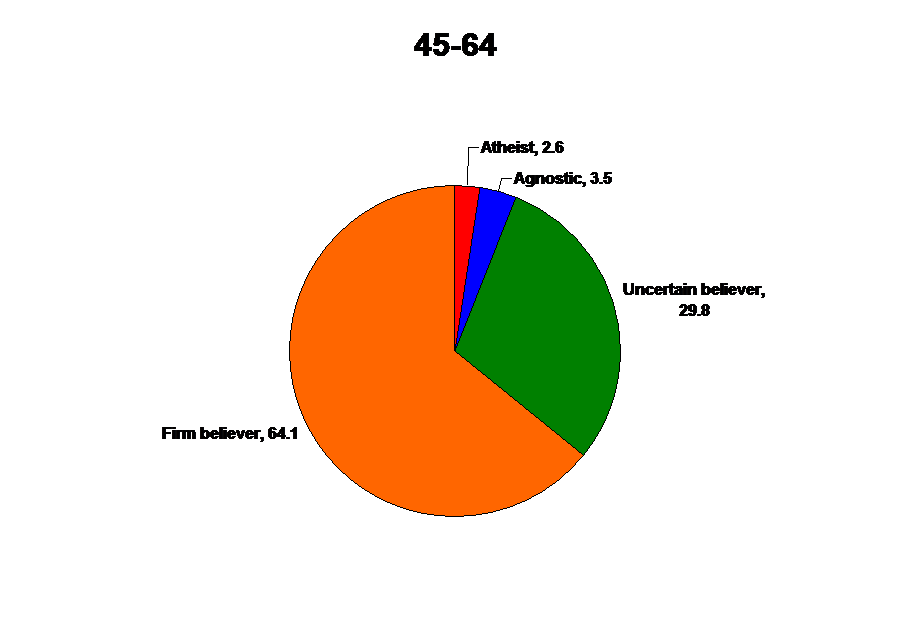
Like children often do, I have many questions. To the GSS I say, "Tell me all your thoughts on God". The following graphs show the percentage distributions for four categories of theistic belief across a host of usual-suspect variables. For contemporary relevance, all results are from 2000 onward. By race:


By sex:

 By political orientation:
By partisan affiliation:


By community type at the age of 16:


By social class:


By age range:


By intelligence*:


By educational attainment:


The quintessential atheist is a high IQ, upper class, urban, white (or Asian), young, liberal Democratic guy with a doctorate. Firm belief is pretty much the norm across the board and a plurality just about anyway one broadly slices it, but the further one moves away from the quintessential atheist, the more theistic things become.

GSS variables used: GOD(1)(2)(3-5)(6), RACECEN1(1)(2)(4-10)(15-16), SEX(1)(2), POLVIEWS(1-3)(4)(5-7), PARTYID(0-2)(3)(4-6), RES16(1-2)(3-4)(5-6), CLASS, AGE(18-29)(30-44)(45-64)(65-89), -WORDSUM(0-3)(4-5)(6)(7-8)(9-10), EDUC(0-11)(12)(13-15)(16-17)(18-20), YEAR(2000-2010)

* For intelligence, respondents are broken up into five categories that come to roughly resemble a normal distribution; Really Smarts (wordsum score of 9-10, comprising 13% of the population), Pretty Smarts (7-8, 26%), Normals (6, 22%), Pretty Dumbs (4-5, 27%), and Real Dumbs (0-3, 12%).

Friday, February 15, 2013

Marshaling evidence from the GSS, Jayman has thoughtfully and diligently looked at white fertility rates by political orientation over time. The tendency for conservatives to be more fecund than liberals extends at least as far back as the cohort of people born in the 1920s, and it has become more pronounced since then. Jayman argues this presages a future in which whites become, on average, increasingly conservative in their political outlooks. Given the partial heritability of political orientation, this is a plausible assertion (at least in a relative sense--the political ratchet seems almost inexorably to always turn to the left, with the consequence that oftentimes what was leftist a generation ago is considered mainstream today and what was conservative a generation ago is viewed as being totally beyond the pale today).

I've wondered, though, if the same argument applies to non-whites*. The following graph shows the mean number of children among liberal, moderate, and conservative non-whites by range of year of birth. For consistency, I used the same birth cohorts and years of survey participation as Jayman did:


Like whites, conservative non-whites have been outbreeding liberal non-whites for nearly a century now, yet it hardly seems obvious that non-whites have moved to the right (absolutely or relatively) over the last several decades, nor does it seem a prudent to bet that they will in the future. And the social-versus-economic angle doesn't hopelessly confound here--non-whites are moving to the left on social issues, not just on economic ones.

This epigone isn't an augur so I won't prognosticate about the trajectory of non-white political orientation in the future. I merely hope (though I'm not optimistic) that the political beliefs of tomorrow are recognizable by their ideological flavors rather than by the race and ethnicity of the person espousing them.

GSS variables used: COHORT(1883-1909)(1910-1919)(1920-1929)(1930-1939)(1940-1949)(1950-1959)(1960-1969)(1970-1979), YEAR(1972-2010)(1985-2010)(1993-2010)(2002-2010)(2006-2010), POLVIEWS(1-3)(4)(5-7), CHILDS, RACE(2-3)

* Referring here to those who selected either "black" or "other" from the three choices "white", "black", and "other".

Tuesday, February 12, 2013

Razib's informative post relating Asian-American religious affiliation to electoral behavior spurred me to take a look at the relationship between regular church attendance and partisan affiliation among self-identified Christians in the US over the last several decades. My impression was that the difference in attendance rates by party have become starker over time, Jimmy Carter being more overt about his religion than Barack Obama is and Gerald Ford being considerably less so than the second George Bush was while in office.

It's important to keep in mind that we're looking at those with either a Protestant or Catholic religious affiliation. Non-Christians and those without any religious identification at all are not considered. In a subsequent post I'll take a look at religious affiliation by party over time, but for now let's just consider expressed piety (evaluated by whether or not a respondent attends services on at least a weekly basis) among those who identify as Christians. To avoid racial confounding, the analysis is limited only to whites. Note also the range display from 15%-45% of the self-identified Christian population. Even among white Christian Republicans, it has persistently been the case that only a minority attends services on a regular basis:


Independents and moderates are, on the whole, less knowledgeable and less actionable than committed ideologues and partisans are, and that shows up here as well. The tendency among Christians for Republicans to be more religiously active than Democrats and moderates existed at least as far back as the early seventies, continued over the course of that decade, and had become pretty firmly established by the time Reagan left office. The partisan gap has only widened since then.

That said, the differences aren't stark. Today we'd report them by saying that while 4-in-10 Christian Republicans attend services at least once a week, only 3-in-10 Christian Democrats do. Quite similar, really. I suspect the bigger story is in the drop off in Christian identification among Democrats (but not among Republicans) over the same time span.

GSS variables used: RELIG(1-2), RACE(1), PARTYID(0-1)(3)(5-6), ATTEND(0-6)(7-8)

Wednesday, February 6, 2013

In government we trust?

Just in time for the bipartisan, full-court amnesty press, Pew provides some insight into why our political class is so eager to elect a new people. The research center surveyed people in the US on the levels of trust they have in the federal government.

Guess which group was the most likely to say that they can "trust the government in Washington to do what is right". This group reports higher levels of trust in the federal government than blacks or even self-described liberal Democrats do. Hint: The GOP's response to Obama's state of the union address will be given by an invade-the-world, invite-the-world neocon who will be delivering said response in both English and Spanish.


Saturday, January 19, 2013

Who owns guns?

Since its inception, the GSS has asked respondents whether or not they have a gun in the house. Seems like a germane topic for consideration at the moment. For contemporary relevance, everything we'll look at here comes from 2000 onward. Fewer than 1% of respondents refused to answer the question and are consequently excluded from all analyses.

John Derbyshire contends that the gun control debate is a contest of moral posturing between two very culturally distinct groups of whites:
This is really about is good old American sectionalism—two big groups of white people who can’t stand the sight of each other. We are eternally re-fighting the Civil War. 
(Yes, white people. Blacks are hors de combat here, as they mostly were in the Civil War, neither side of which liked or trusted them. Sherman would not let colored troops march armed in the Grand Parade. Some black pioneer units marched with picks and shovels, but they were regarded as comic relief by the spectators and newspapers. Nobody cares what the generality of blacks think, no more now than in 1865. This war, like that one, is an intra-white affair.)
While NAM opinion may not feature prominently in pronouncements from either white faction, Steve Sailer argues that SWPLs favor strict control as a means of disarming NAMs in the urban areas the two groups share. A direct assault on NAM culture being of course unthinkable, SWPLs divert their contempt for gun rights from NAMs and towards white rustic bumpkins. To the extent that NAMs factor into the thoughts of said bumpkins, it's that in the bucolic places they call home, low population density means police manpower and response times are too low to be relied upon. Consequently, each man need be responsible for his own self defense.

In the midst of this fray, it may come as a surprise to many to find that whites are significantly more likely to own firearms than non-whites--including Asians--are. The percentages of Americans who have at least one gun in the home, by mutually exclusive racial/ethnic identity (n = 7,214):

RaceHas gun
White42.1%
Native American38.4%
Black20.0%
Hispanic11.0%
Asian10.5%

While gun advocates often invoke the weapon as the great equalizer for allowing a petite woman to defend herself from a larger, stronger male assailant, men are more likely to own firearms than women are. The percentages of people who have at least one gun in the home, by sex (n = 8,164):

SexHas gun
Male41.7%
Female29.9%

Getting back to the racial angle, as previously mentioned, whites aren't monolithic. There is an ideological divide on the issue of gun rights among whites that is reflected in varying rates of gun ownership. The percentages of whites who have at least one gun in the home, by political orientation (n = 3,998):

PoliticsHas gun
Conservative55.4%
Moderate41.9%
Liberal26.9%

Gun ownership rates are more than twice as high among white conservatives as they are among white liberals. Circling back to the previous table, though, note that even white liberals are more apt to have guns in the home than blacks, Hispanics, or Asians are.

There is a geographic component at play here as well. The GSS has only sporadically inquired about the type of community respondents currently live in, but from the beginning has asked where they lived at the age of sixteen. Understanding that the following measurement is imperfect not only because people move but also because geographic distinctions recalled from decades in the past are inevitably somewhoat murky, the percentages of whites who currently have at least one gun in the home, by the type of community they were living in at the age of 16 (n = 5,526):

CommunityHas gun
Rural56.6%
Suburban40.9%
Urban31.6%

There is a good deal of overlap between political orientation and community type among whites, but they obviously don't map identically. If we distill the white camps down to their most essential elements, we get  single urban SWPLs on one side and married God-and-country farmboys on the other. The proportion of unmarried urban white liberals with at least one gun in the home is 13.6%; the corresponding figure for married rural white conservatives is 72.1%. It's here that the battle lines are most conspicuously drawn.

Pat Buchanan recently wrote the following:
Today, we Americans are a far more heavily armed people than half a century ago. Forty-seven percent of adult males own a firearm. There are 270 million rifles, shotguns and pistols in private hands.
The man knows his stuff, but Pat doesn't provide a point of reference from which to base the assertion made in that first sentence upon. The reflexive gun-buying spree that has occurred in response to calls for stricter gun control from nanny-staters like Obama and Michael Bloomberg notwithstanding, the American public appears to have been more heavily armed in the past than they are today. Making an exception to the 2000 onward rule established earlier, the following graph shows the percentage of Americans with at least one gun in the home from 1973 through 2010, the last year for which GSS data were available at the time of this posting (n = 32,863):


Pat comes to the following conclusion based on the claimed increase in private gun ownership:
Given the loosening of gun laws at the state level in recent years, the gun controllers no longer have the numbers to impose their will on the folks who have a love for, or feel a need for, guns.
While most American households don't contain firearms, many do. The trend has been away from gun ownership (given demographic trends, this really isn't surprising) over the last several decades, but I suspect that gun rights still have the upper hand over gun restrictions, at least at present. Presumably the vast majority of Americans who own guns want to keep them, while there are copious quantities of residents among the gun-free majority (like myself) who sympathize with the spirit of the second amendment, are wary of government intervention into the  private lives of citizens, and who like thinking that because a number of their neighbors own guns, would-be burglars are taking a gamble assuming that they do not.

GSS variables used: OWNGUN(1-2), RACECEN1(1)(2)(3)(4-10)(15-16), POLVIEWS(1-2)(4)(6-7), MARITAL(1)(2-5), RES16(1-2)(3-4)(5-6), YEAR(2000-2010)

Saturday, December 29, 2012

Pew induces puking

A little with this report, anyway. Pew Research is an admirable organization that has given me buckets of food for thought and more than my share of blogging material to make use of, all without asking anything of me in return. Countless hours of entertainment for free. What could the organization possibly owe me? If anything, I owe it. Still, while this report might not be the Worst. Report. Ever., omission and obfuscation abound.

Entitled "A Bipartisan Nation of Beneficiaries", it opens by showing that a full 59% of Obama voters and 53% of Romney voters received benefits from at least one of the six major entitlement programs considered. Wow, looks like "the 47%" thing was an understatement! Voters tend to be a notch above non-voters and yet majorities of both parties' electorates are welfare queens! This graphic, presented later in the report, sheds some light on why the recipient percentages are so high, however:


Virtually all seniors have been on the public dole because medicaid and especially social security--which is there for the taking for everyone, the only restriction being geriatric--are included in the analysis. With the 65+ age bracket breaking 56%-44% for Romney, the inclusion of these universal old age government-provided benefits stacks the deck to make it appear as though Obama voters were hardly any more likely to be feeding at the public trough than Romney voters were. That, of course, is technically accurate, and it sheds some light on how politically perilous the Ryan budget plan was. Excepting defense, cuts in the rate of growth in these programs are among the least offensive to the Democratic party. But in the public mind, social security is something everyone pays into and subsequently is entitled to take from, while things like TANF and food stamps are there for those who are incapable of providing for themselves.

If Pew spun the findings as noted above but disaggregated the data in the index of the report, I wouldn't be whining, but the organization doesn't. It would be nice to know, for instance, the electoral breakdown among medicaid, TANF, food stamps, and unemployment insurance recipients without the inclusion of social security (which has the greatest number of recipients among the six programs considered) and medicare recipients in the mix. As written, the report clearly indicates that Pew has the data broken out in such a manner but intentionally doesn't report it as such, as doing so would show that the takers are squarely in Obama's camp.

There is still something to be gleaned from the report as is that will be of interest to regular readers, however. It's well known in these parts that women are leading the way towards our progressive leftist future. If only men had voted in November, Romney would've won as convincingly as Obama actually did. Why do women--especially the unmarried ones--like the welfare state so much? Because men foot the bill for it while they enjoy the lion's share of the benefits it provides. The percentages, by sex, who use none, one, two, and three or more of the six entitlement programs:

Sex0123+
Men51%23%15%12%
Women39%22%19%19%

Sunday, December 23, 2012

The gun gap

Writes Jack Hunter:
In the cause of preventing future tragedies, it would make FAR more sense to ban the media from ever mentioning the names of these evil murderers than to further restrict guns. Think they'll give up their 1st Amendment rights? For public safety?
Ever the proverbial fool, after seeing that pithy rhetorical ploy I knew I had to say something.

The Herostratus effect must be an order of magnitude larger than any further attempts to restrict the public's access to guns could hope to be. A decade their senior and having never toked up in my life--despite the multi-billion dollar, decades long drug war--there are several teenagers I know who I could go to if I wanted to have marijuana in front of me within the hour. Not only do far more people want guns than want weed, the sale only has to occur once for the potential 'problem' to persist in the case of firearms. With drugs it must happen over and over and over again. The idea that the government has the capacity to control gun access is beyond risible.

Then there are Pinterest-primed pieces of propaganda like this that, despite their cheap polemical attractiveness, carry with them a cautionary message worth contemplating:


But this might provide a clearer explanation for why gun control is a perennial objective of the leftist Establishment:


The inverse correlation between the percentage of a state's population that owns guns and Obama's share of the vote in 2012 is a vigorous .78 (p = 0). This is affordable family formation territory. Gun ownership rates thus 'explain' over 60% of how the states voted. Parenthetically, the most conspicuous outlier is Vermont, a deeply blue but also very rural state that has a fairly high number of firearms in it. Removing it from the analysis (not that there is necessarily any reason to do so) pushes the correlation up to .82.

Gun ownership rates tell a lot more about a state's political orientation than they do about its residents proclivity for violence. In fact, there is no meaningful relationship between gun ownership and homicide rates at the state level (r = .09, p = .52).

Tuesday, December 11, 2012

The left's anti-natalism

Commenter "Dan" wrote the following in a couple of places:
Here are 10 areas off the top of my head where ‘liberal’ theology is anti-natalist: 
1 – Pro-Life versus pro Choice (duh) 
2 – Worshiping the Cathedral (specifically higher education); the more time you are in higher ed, the less time you have to have children 
3 – Feminist careerism – can’t be in the kitchen cooking dinner for your kids if you are in the corporate boardroom, or most any demanding job 
4 – Antagonism toward religion – most religions are pro natalist to varying degrees 
5 – Feminist insistence in the sameness of men and women – makes women much less attractive to men 
6 – View of marriage as a patriarchal instrument of oppression – Children are much more likely to spring forth from married people 
7 – Upholding birth control as a fundamental human right (and forcing every institution to give it away for free) 
8 – The environmentalists view of humans basically as a scourge on the planet 
9 – Liberals’ attachment to urban living puts them in a setting not conducive to having children 
10 – Young liberals’ belief that they have a human right to pursue a field that is not economically viable means of course that they will not be able to, you know, support anybody.  
Oh, gosh and I forgot the most obvious ones of all! 
11 – Male homosexuality as the holiest and most righteous form of goodness that there is. 
12 – Lesbianism as the other holiest and most righteous form of goodness that there is.
Great list. How about a contrarian perspective? In what ways could it be argued that the contemporary left is pro-natalist (even if its adherents don't always put the putatively preferred behavior into practice)? Here's off the top of my head:
- More supportive of alternative fertility methods like IVF than many socially conservative organizations are 
- Minimal hostility for 'statutory' rape between consenting people (think the Roman Polanskis of the world) 
- Hostility towards Project Prevention and similar efforts 
- Supportive of the welfare state, which plays the provider role for absent fathers (and deadbeat parents in general) 
- Relatedly, exhibits lesser to non-existent condemnation of single motherhood and teenage pregnancy 
- In favor of more lenient sentencing for convicted criminals, meaning thugs are back out scouring the street sooner 
- Supportive of unrestricted immigration, with one consequence being lots of highly fertile settlers from south of the border making babies in the US
Additions/suggestions for both lists are solicited in the comments section, please.

Only the first item could be considered both pro-natalist and eugenic, or at least not blatantly dysgenic. That Dan's list of anti-natalism characteristics is primarily directed at the white middle and working classes, while the pro-natalist list is especially relevant to NAMs is not a coincidence. Don't misconstrue a little devil's advocate work on my part as indicative of support for the civilizational destructiveness cheered on by the left.

Saturday, November 24, 2012

Time to abort opposition to abortion?

Reflecting on the 2012 presidential election, Half Sigma writes:
Republicans are on the losing side of the abortion issue. It doesn’t matter that Romney, personally, didn’t make abortion a big issue. Everyone knows that Republicans are against abortion, and he selected a staunchly anti-abortion Vice Presidential nominee in Paul Ryan. That the Republican Party has morons like Richard Mourdock who think that the demon-spawn of rapists are a “gift from God” only makes things that much worse.
The Edison exit polls, paid for and reported on by the major media, didn't query voters on abortion at the state level, but Reuters has the information. The following shows the public split on the legality of abortion in the nine tightest swing states as well as in Michigan, Minnesota, and Pennsylvania--mostly white, moderate places that it is imperative for the GOP to convert to red to maintain electoral viability in the face of demographic trends (read Hispanic immigration and fecundity) coloring states like Colorado, Arizona, Florida, Nevada (which has probably already crossed the rubicon)--and eventually even strongholds like Texas--blue. The "legal" column is comprised of those saying abortion should be legal in "most" or "all" cases; the "illegal" column of those responding it should be illegal in "most" or "all" instances. The "unsure" contingents are ignored:

StateLegal %Illegal %
Nevada69.330.7
New Hampshire67.632.4
Colorado62.337.7
Florida62.337.7
Pennsylvania60.939.1
Virginia60.339.7
Ohio56.943.1
Minnesota56.743.3
Michigan56.143.9
Wisconsin55.144.9
Iowa53.746.3
North Carolina53.446.6

In all twelve of the states under consideration, the pro-choice position is held by a majority of the electorate. And in places like Virginia and Colorado--just a decade ago seemingly reliably Republican--there exists pro-choice 'super majorities'. If the GOP isn't able to enlist the states with old America demography--Ohio, Iowa, Wisconsin, Minnesota, Michigan, and Pennsylvania--in a hurry, it's conceivable to me that I'll never see another Republican president in my lifetime. The above strikes me as reasonable evidence that the part of the official 2012 Republican National Committee platform that reads as follows makes this crucial task even more difficult to accomplish:
We support a human life amendment to the Constitution and endorse legislation to make clear that the Fourteenth Amendment’s protections apply to unborn children. We oppose using public revenues to promote or perform abortion or fund organizations which perform or advocate it and will not fund or subsidize health care which includes abortion coverage. We support the appointment of judges who respect traditional family values and the sanctity of innocent human life.
HS thinks dropping the pro-life platform (along with a determination to hold the line on tax rates for high earners) from the national ticket is the way to get there. The I'm-no-political-strategist disclaimer assumed, the GOP should take a 10th amendment states' rights tact on abortion. It'll retain the pro-lifers (because hey, at least the federal government won't be against us*) without turning off SWPL whites, who don't do much aborting of their own but who like to think they'd be able to if the need ever arose. Taking a page from Gary Johnson's playbook, it could even be pitched as being the ultimate 'pro-choice', position. Onward, liberty!

* In states like Mississippi (37.8% legal, 62.2% illegal), abortion could be outlawed entirely, although there'd undoubtedly be some rhetorical adroitness required to deal with the charge that to get to a states' rights spot on abortion, Roe v Wade would have to be revisited.
ban nha mat pho ha noi bán nhà mặt phố hà nội